TopAgent IC – AI Platform Coordinating the Robot Ecosystem for Vietnamese Businesses
In the robot ecosystem, the platform acts as a business coordination layer on top of the fleet manager and device controllers, helping turn operational goals into context-aware tasks, track results, and support exception handling.
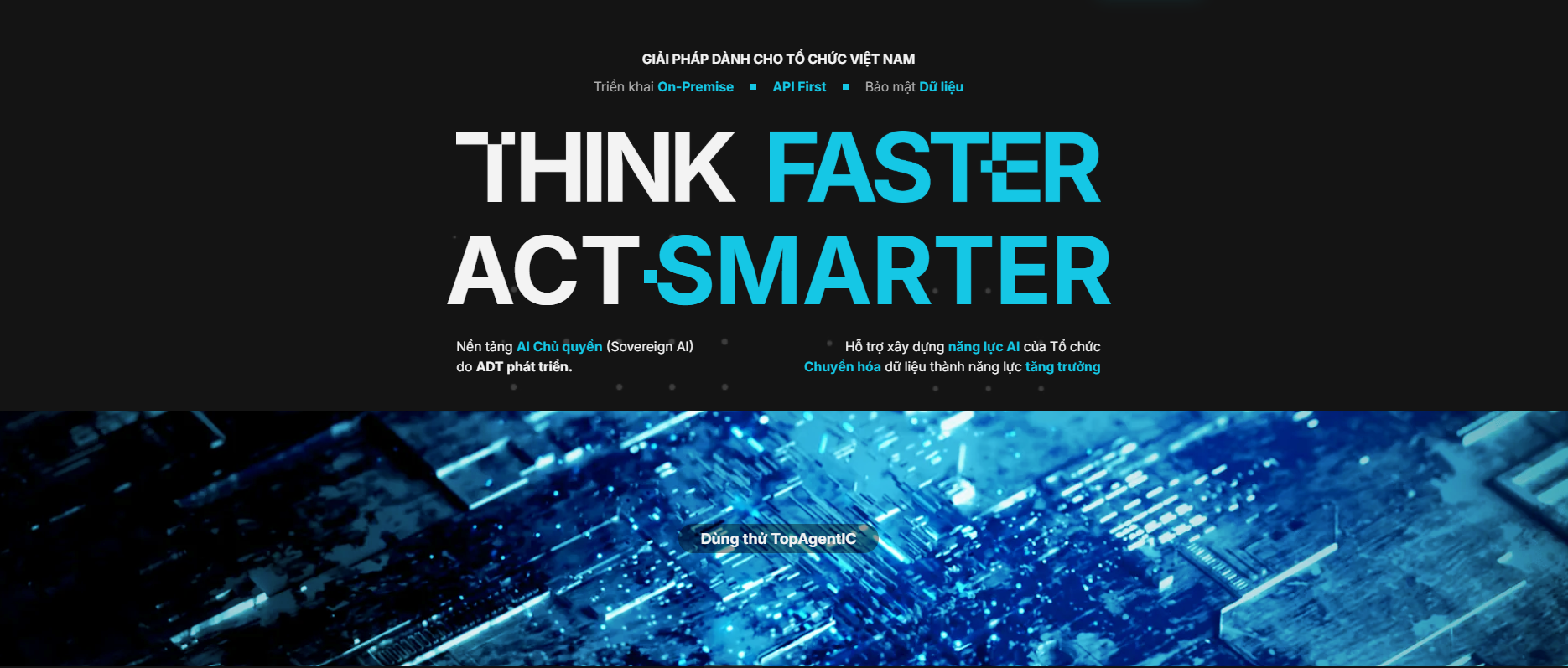
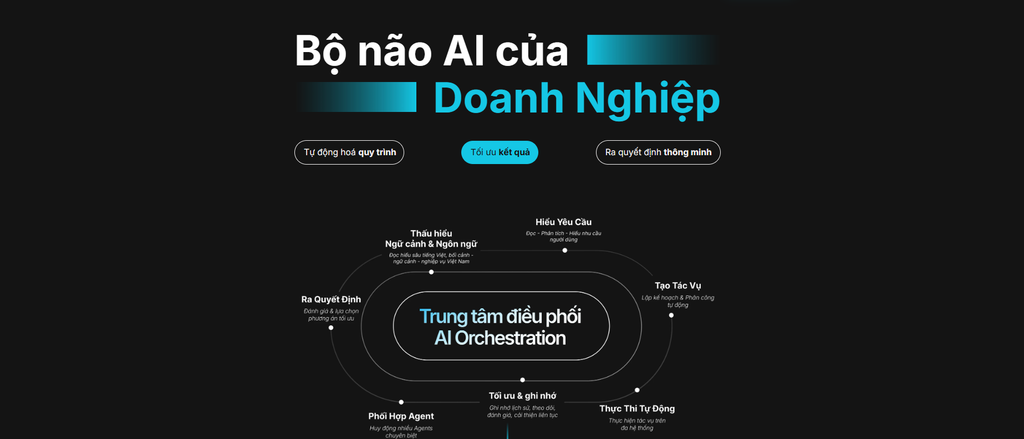
TopAgent IC is a sovereign AI platform developed by ADT, designed to unify enterprise data, orchestrate AI Agents, and connect Physical AI systems. Within a robotics ecosystem, the platform serves as a business orchestration layer above fleet managers and device controllers, translating operational objectives into context-aware tasks, tracking outcomes, and supporting exception handling.
When autonomous mobile robots, inspection robots, and service robots operate across separate software systems, enterprises still have to coordinate operations manually and consolidate data from multiple sources. The next challenge is to build a “brain” that connects data, AI Agents, business processes, and existing control systems — a role that a robot orchestration AI platform like TopAgentic aims to fulfill.
1. What Is TopAgent IC?
TopAgent IC — the platform’s official product name — is positioned by ADT as a sovereign AI platform designed for Vietnamese organizations. Its official website outlines three key deployment principles: on-premise deployment, an API-first architecture, and data security. The platform also supports AI Agents, Agentic AI, and Physical AI.
The platform aims to establish an AI layer capable of:
- Connecting internal data and knowledge within authorized access scopes.
- Orchestrating multiple specialized AI Agents for different business functions.
- Selecting suitable AI models for specific tasks.
- Integrating enterprise systems and devices through APIs.
- Tracking workflows from initial requests and processing to final outcomes.
In robotics applications, TopAgent IC does not replace real-time controllers, safety systems, or fleet managers. Instead, it operates at the business orchestration layer: understanding objectives, consolidating contextual information, prioritizing tasks, monitoring progress, and routing exceptions to the appropriate personnel.
2. Why Does a Robot Ecosystem Need an AI Orchestration Layer?
As operations scale, robot tasks depend on multiple systems:
- WMS identifies inventory locations and stock status.
- MES provides production plans and production status.
- ERP contains orders, resources, and business priorities.
- CMMS manages maintenance and equipment history.
- Fleet managers allocate tasks and coordinate robot traffic.
- Operations personnel handle approvals and exceptions.
Without integration, a robot may complete its journey without serving the overall operational priority — for example, delivering materials to a production line that is currently stopped. The AI layer transforms distributed data into actionable context, recommends an approach, and forwards confirmed requests to the fleet manager. Execution status is then returned to update reports or trigger subsequent steps.
3. TopAgent IC Robot Orchestration Architecture
A practical deployment model can be organized into five layers:
Layer 1: Data and Business Systems
ERP, MES, WMS, CMMS, and IoT systems provide context about orders, inventory, machine capacity, and equipment conditions.
Layer 2: TopAgent IC and AI Agents
TopAgent IC consolidates context and orchestrates specialized Agents for production, warehousing, maintenance, or reporting. The Multi-Agent approach distributes responsibilities instead of routing every request through a single general-purpose assistant.
Layer 3: Integration and Task Governance
APIs or middleware route requests between the AI platform and existing systems, with policies governing data access, permissions, approvals, and audit logs.
Layer 4: Fleet Managers and Controllers
Fleet managers select robots, manage traffic, battery levels, and task queues. In multi-vendor environments, VDA 5050 can support communication with central control systems, depending on device compatibility.
Layer 5: Robots and Physical Devices
AMRs, AGVs, autonomous forklifts, and service robots execute tasks. Safety must be handled by the appropriate devices and control systems rather than delegated entirely to a language model.
4. How Is a Task Orchestrated?
Consider a production line that needs an additional pallet of raw materials:
- MES identifies the demand based on the production plan or current production status.
- The production Agent analyzes task priority and checks relevant conditions.
- The warehouse Agent queries WMS to determine the pallet location and delivery point.
- TopAgent IC consolidates the context, applies approval rules, and forwards valid requests to the fleet manager.
- The fleet manager selects a suitable robot, calculates its route, and executes the task within defined safety constraints.
- Completion status or exceptions are returned so the Agent can update systems, generate alerts, or recommend the next step.
AI does not control every robot movement. Its value lies in understanding objectives, coordinating data, and maintaining workflow continuity.
5. Core Capabilities of TopAgent IC in a Robot Ecosystem
Multi-Agent Orchestration
Warehouse, production, maintenance, and management Agents handle their respective responsibilities while sharing context, enabling clearer permission boundaries and easier scalability.
Multi-Model Architecture
A multi-model architecture allows the platform to select suitable AI capabilities for document reading, data analysis, reasoning, or Vietnamese-language processing.
API-First Integration
The API-first approach facilitates integration between TopAgent IC and ERP, MES, WMS, fleet managers, and data platforms, depending on the available APIs.
Deployment for Sovereign AI
On-premise deployment or dedicated architectures help organizations control where data is processed. On-premise deployment still requires access controls, encryption, audit logs, and risk assessments.
Data Consolidation and Reporting
Information from robots, warehouses, and production systems can be consolidated for queries, alerts, and reporting. Results depend on source data quality and system configuration.
6. Enterprise Application Scenarios
- Internal logistics orchestration: Connect production requests with inventory data and AMR/AGV fleets.
- Production-line material replenishment: Prioritize tasks based on actual production progress and material shortages.
- Inspection and maintenance: Assign tasks to robots equipped with cameras or sensors, then route the collected data to technical Agents for analysis.
- Exception management: Detect stopped robots, occupied delivery points, or overdue tasks and escalate them to the appropriate personnel.
- Service and reception robots: Connect robots with knowledge bases, work schedules, or organizational reception workflows.
- Management reporting: Consolidate robot fleet performance, waiting times, intervention rates, and operational bottlenecks.
The actual scope must be validated against each enterprise’s devices, APIs, data policies, and safety requirements.
7. Value for Vietnamese Enterprises
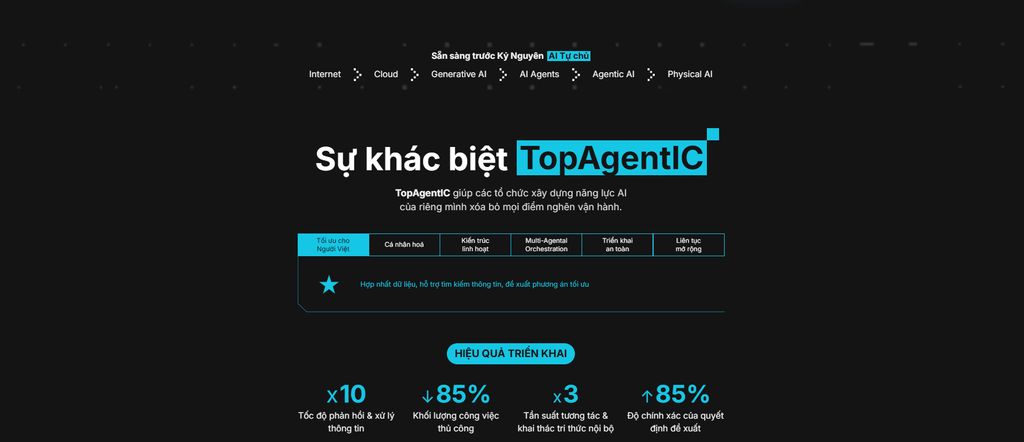
TopAgent IC connects three key needs: knowledge utilization, AI Agent-driven automation, and Physical AI orchestration.
Connect operations with management: Device-level data can be consolidated into actionable insights to support operational decision-making.oại. Giá trị cần đo trên quy trình thật bằng thời gian chu kỳ, tỷ lệ hoàn thành, thời gian chờ, mức can thiệp, ngoại lệ và chi phí.
Adaptation to the Vietnamese context: Supports the design of Agents around Vietnamese language, industry terminology, and internal workflows.
Data control: Offers deployment options suited to infrastructure and security requirements.
Leverage existing systems: Enables integration around specific use cases without replacing the entire ERP, MES, or WMS infrastructure.
Modular scalability: Start with a single robotic workflow and add Agents, data sources, or devices once the initial solution has demonstrated its effectiveness.
8. Implementation Roadmap for TopAgent IC in a Robot Ecosystem
- Select a use case: Identify a workflow with clearly defined start and end points, data inputs, and KPIs.
- Assess existing systems: Review robots, fleet managers, ERP/MES/WMS, APIs, network infrastructure, and access permissions.
- Define Agent responsibilities: Determine which Agents can access data, make recommendations, approve requests, or create tasks.
- Establish safety boundaries: Keep motion control and emergency stop functions within dedicated systems, referencing applicable standards such as ISO 3691-4:2023 for driverless industrial trucks and their systems.
- Run a pilot: Deploy the solution on a limited scale and measure KPIs before and after implementation.
- Standardize and scale: Finalize logging, exception handling, training, and contingency plans before expanding the number of robots or workflows.
9. From Sovereign AI to Operational Physical AI
Sovereign AI enables organizations to control their data, models, infrastructure, and processes, while Physical AI extends these capabilities into the physical world. TopAgent IC sits at the intersection of these two domains, using internal data to orchestrate AI Agents and connect their outputs to operational systems within established boundaries. This enables robots to participate in context-aware workflows with defined permissions, traceability, and human oversight.
Conclusion
TopAgent IC — a robot orchestration AI platform for Vietnamese enterprises — should not be understood as a replacement for fleet managers or dedicated robot controllers. Its appropriate role is to serve as the business orchestration layer: connecting data, coordinating AI Agents, translating objectives into tasks, and consolidating results from physical systems.
Enterprises should begin with a specific use case, validate integration capabilities, and measure performance in real-world operations. When data, AI Agents, fleet managers, and robots are connected at the appropriate layers, TopAgent IC can provide a foundation for scaling from isolated automation to a unified, governed Physical AI ecosystem.
Explore TopAgent IC — the sovereign AI platform developed by ADT or contact ADT for consultation on an integration architecture tailored to your enterprise’s existing robotics systems and data infrastructure.
Frequently Asked Questions (FAQ)
What is TopAgent IC?
TopAgent IC, also known as TopAgentic, is a sovereign AI platform developed by ADT for Vietnamese organizations. It supports AI Agent deployment, multi-agent orchestration, multi-model integration, and system connectivity through APIs.
Does TopAgent IC directly control robot movements?
The platform’s appropriate role is to orchestrate operational objectives and business workflows. Movement control, obstacle avoidance, emergency stops, and other safety functions must remain within dedicated robots, controllers, or fleet management systems.
How is TopAgent IC different from a fleet manager?
A fleet manager assigns tasks and manages traffic across a robot fleet. TopAgent IC uses context from enterprise systems to identify operational needs, prioritize tasks, manage approvals, and monitor workflows at a higher level.
Can the platform connect robots from multiple manufacturers?
This depends on the APIs available from the robots, fleet managers, and middleware, as well as supported communication standards. Enterprises should assess compatibility before deployment rather than assume every device can connect directly.
Can TopAgent IC be deployed on-premise?
The official TopAgentic website identifies on-premise deployment as a supported deployment direction. The final architecture should be designed around each organization’s infrastructure, data, scale, and information security requirements.
Where should enterprises start?
Choose a robotic workflow with clearly defined inputs, delivery points, and KPIs. Then assess API compatibility, establish Agent permissions and safety boundaries, and run a pilot on a limited scale.