What is Multi-Agent AI? Architecture and applications in businesses
A general-purpose AI assistant can struggle to handle requests that span multiple areas of expertise reliably. Multi-Agent AI assigns specialized Agents within a unified workflow. Its value depends on roles, handoffs, access permissions, and human control points.
A general-purpose AI assistant can struggle to handle requests that span multiple areas of expertise reliably. Multi-Agent AI assigns specialized Agents within a unified workflow. Its value depends on roles, handoffs, access permissions, and human control points.
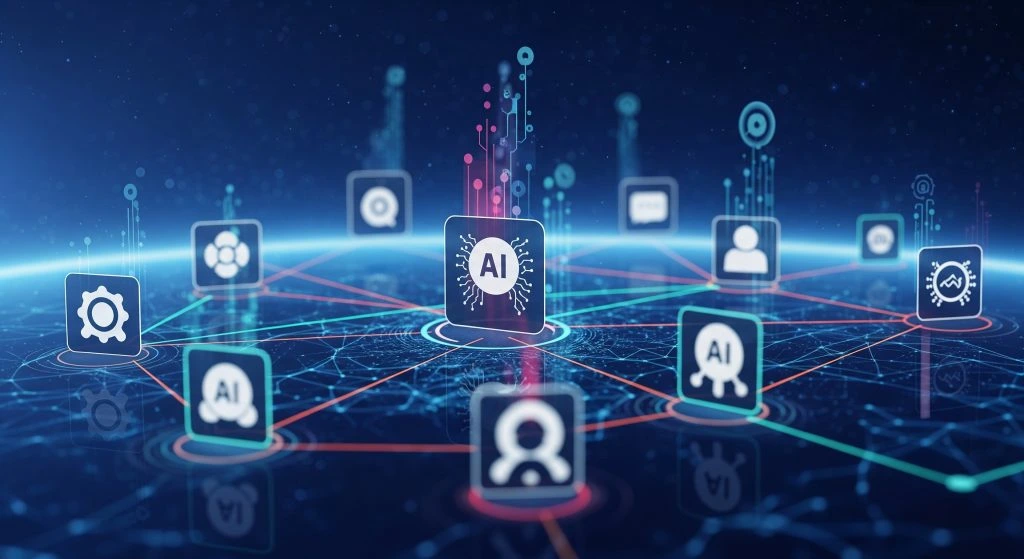
Multi-Agent AI consists of multiple AI Agents, each with its own role, working together toward a shared goal. The architecture includes an intake layer, an orchestrator, specialized Agents, data, tools, and governance. The model suits complex workflows, but permissions, cost, latency, and quality must be controlled.
What is Multi-Agent AI?
Multi-Agent AI, or a multi-agent AI system, is a model in which multiple intelligent agents work together to solve a single task. Each Agent has its own role, instructions, data, tools, and scope of permissions.
For example, in a report-writing workflow, Agents take turns finding data, analyzing it, checking it, and standardizing the content. The orchestrator selects the Agent, passes results along, and ends the workflow.
Microsoft’s AutoGen research describes applications in which multiple Agents converse to complete tasks, combining language models, tools, and human input.
This model is not simply placing several chatbots side by side. The difference lies in role assignment, coordination flow, shared state, and control over results.
How does Multi-Agent AI differ from a single AI Agent?
A single Agent suits narrow tasks with few tools. Multi-Agent AI suits workflows that involve multiple areas of expertise, independent pieces of work, or a need for cross-checking.
| Criteria | Single AI Agent | Multi-Agent AI |
|---|---|---|
| Scope | One role or a group of closely related tasks | Multiple roles within the same workflow |
| Orchestration | Simple processing flow | Requires rules for assigning work and handoffs |
| Data and tools | One main group of sources | Permissions can be set per Agent |
| Control | Monitoring a single agent | Monitoring each Agent and the whole flow |
| Cost and latency | Usually lower | May grow with the number of coordination rounds |
If an agent has already completed the stability task, adding more agents might just increase costs and errors.
Multi-Agent AI Architecture in Enterprises
A Multi-Agent AI architecture typically consists of six components:
- Intake layer: receives tasks via chat, apps, or API; standardizes goals, inputs, and outputs.
- Orchestrator: analyzes the task, selects Agents, and manages the processing flow according to rules or context.
- Specialized Agents: take on roles such as search, analysis, drafting, or compliance checking.
- Data and memory: define shared context, private data, and policies for storing, updating, and deleting.
- Integrated tools: connect document repositories, CRM, ERP, email, or calendars with the minimum necessary permissions.
- Governance and monitoring: record tools used, errors, and results; evaluate each Agent and the whole workflow.
Microsoft Agent Framework lists sequential, concurrent, handoff, group chat, and manager Agent orchestration patterns. NIST’s AI RMF also emphasizes risk management throughout the AI lifecycle. This is especially important because errors can propagate between Agents.
Common Coordination Patterns
- Sequential: each Agent receives the previous Agent’s result in a fixed order.
- Parallel: multiple Agents handle independent pieces of work, then the results are merged.
- Handoff: an Agent passes the task to the appropriate specialty based on context.
- Manager Agent: one Agent plans, assigns work, and tracks progress.
- Cross-checking: a second Agent verifies the basis or errors in the output.
Every pattern needs rules for resolving conflicts, loop limits, and stopping conditions.
5 Applications of Multi-Agent AI in Enterprises
- Research and reporting: find documents, extract facts, cross-check sources, and standardize content.
- Customer care: classify requests and route them to product, technical, or policy Agents.
- Sales: summarize needs, look up solution information, draft proposals, and check requirements.
- Operations: monitor orders, inventory, and shipping to detect anomalies or propose options.
- Finance and compliance: classify documents, reconcile data, and flag transactions for review.
All of these applications need reliable data sources and a mechanism for escalating to staff when a request exceeds scope. Prices, commitments, terms, legal conclusions, and final financial decisions must be approved by an authorized person.
Benefits and Risks to Evaluate
Multi-Agent AI provides modularity and allows role-based permissions. In return, incorrect facts can spread; Agents can repeat tasks, use tools beyond their scope, or produce inconsistent results. Multiple processing rounds also increase cost and latency.
| Expected value | Risk | Control |
|---|---|---|
| Specialization | Overlapping roles | Define inputs and outputs |
| Parallel processing | Conflicting results | Merge rules, priority sources |
| Multi-step automation | Error propagation | Stage-by-stage checks |
| System connectivity | Overly broad permissions | Least-privilege access, logs |
| Workflow scaling | Hard to track | Observe the entire flow |
Multi-Agent AI Deployment Checklist
Start with a workflow that has clear inputs, outputs, and measurement criteria. Only split into Agents when role assignment creates value.
- Choose a task with clear value and manageable risk.
- Describe each Agent’s role, data, tools, and permissions.
- Choose the coordination pattern and handoff conditions.
- Limit time, number of loops, and processing budget.
- Test each Agent and the final result.
- Add human approval at high-impact points.
- Monitor quality, cost, latency, and rework rate.
With an enterprise AI Agent platform such as TopAgent IC, organizations can build specialized assistants and connect data and tools through configuration. The specific coordination flow must depend on the features enabled, the integrated systems, and governance policies.
When is Multi-Agent AI not yet needed?
A business does not yet need a multi-agent system if the problem is simple, data is limited, or instant responses are required. A well-designed single Agent is a suitable starting point; expand only when testing proves the benefit.
Conclusion
Multi-Agent AI helps solve complex workflows through multiple specialized Agents. The value lies in roles, data, permissions, handoffs, and control. Businesses should pilot on a small scale and keep humans at important decision points. Contact ADT Global to discuss Multi-Agent AI architecture and a suitable roadmap on TopAgent IC.
Frequently Asked Questions About Multi-Agent AI
What is Multi-Agent AI?
It is a system made up of multiple AI Agents, each with its own role, working together under a coordination mechanism to achieve a shared goal.
Is Multi-Agent AI better than a single AI Agent?
Not always. A multi-agent model suits workflows that involve multiple areas of expertise; a single Agent is usually more effective for simple tasks.
What does the Agent orchestrator do?
The orchestrator receives the task, selects Agents, manages the order of execution, passes results along, and checks the stopping conditions.
Can Multi-Agent AI run fully on its own?
The level of automation depends on the design and the permissions granted. High-impact tasks should still require human approval.
Where should a business start?
Choose a workflow with a clear scope, define roles, limit permissions, build a test set, and expand only after measuring effectiveness.