4 reasons autonomous robots need to integrate sovereign AI
Exploring the paradox of energy industry robots and the solution of putting Sovereign AI into autonomous robots to help optimize operations and secure data
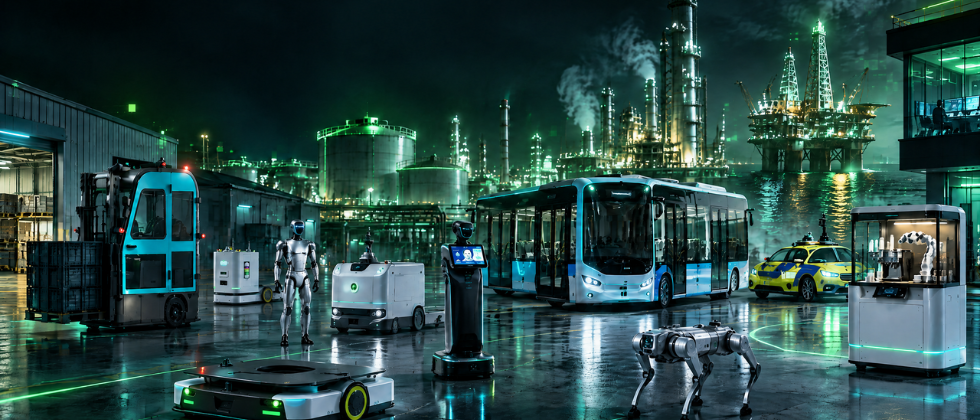
The global energy industry is entering an era of comprehensive automation aimed at reducing risk in harsh working environments. However, dependence on an internet connection is becoming the “Achilles’ heel” of the entire system. Ahead of the Petrovietnam Information Security Conference 2026, bringing sovereign AI technology directly onto edge devices is becoming a must-have trend. Let’s look at how AI-integrated autonomous robots work to optimize operating costs (OPEX) and ensure absolute cybersecurity.
1. The Paradox of AI Autonomous Robots: Cutting-Edge Mechanics, but a Dependent “Brain”
Over the past decade, major energy corporations around the world and in Vietnam have continuously poured millions of USD into modernizing patrol systems at offshore rigs and oil refineries and petrochemical plants. Today’s machines have outstanding mechanical capabilities. They are equipped with ultra-light alloy chassis, expensive LIDAR sensors, and the ability to climb stairs, squeeze into narrow spaces, and withstand extreme temperatures and pressures.
Behind this glamour, however, lies a technological paradox: the “brain” of these AI autonomous robots carries many data security risks. Most industrial robots today act as purely data-collecting machines (gathering camera images and measuring toxic gas and temperature sensors). To make sense of that data, they must transmit an enormous volume of information to a central server (cloud AI) for analysis, and only then receive control commands back.
On the open sea or in remote forest and mountain areas, 4G/5G and internet signals are often unstable due to harsh weather. Just a few seconds of lost connection can cause the system to “freeze” or perform the wrong action, leading to many operational risks.
2. Security: Data Under the Organization’s Control
Information security is the top priority in national critical infrastructure. Image data and operating parameters collected at energy facilities (such as rig structures, field coordinates, and pipeline system diagrams) are highly sensitive and directly related to infrastructure security.
When using third-party cloud AI platforms (public AI), all raw data must travel over public networks, which increases the system’s attack surface.
By contrast, a sovereign AI model integrated on edge devices (Edge AI) allows the autonomous robot to process all information on site:
Internal processing at the edge: Specialized processors (edge NPU/GPU) analyze images and sensor data directly on the device with minimal latency (zero-latency).
Bandwidth optimization: The system does not transmit raw data streams but only sends encrypted text-based alert records (for example, incident identifiers and coordinates).
Data isolation: Original image data is stored locally on the device’s hardware, minimizing the risk of unauthorized access from outside via the network connection.
3. Managing Autonomous Robots with the TopAgent IC Platform
At a large-scale industrial complex such as Petrovietnam’s, a single patrol device is not enough to cover all assets. The problem for managers is how to get dozens of aerial UAVs, underwater ROVs, and ground robots to work together smoothly and share information consistently.
The sovereign AI platform TopAgent IC (developed by ADT Hi-tech) fully addresses this through a multi-agent architecture. This architecture turns each device into an independent “agent” that can still communicate with the others and draw on a shared knowledge base, forming an intelligent robot fleet.
3.1. Asset Integrity management with the power of computer vision
Take the example of real-world deployments of corrosion management solutions such as CORROVISION and CORROPIPE. Instead of manual visual inspection, which requires engineers to physically enter dangerous areas, robots equipped with high-resolution cameras can automatically record and classify the level of material corrosion.
If a ground robot detects an anomaly beyond its reach, the system automatically sends an internal signal to dispatch an unmanned aerial vehicle to approach the area from above. Applying this structure helps reduce periodic inspection time and optimize personnel costs for maintenance work.
3.2. Natural Vietnamese voice interaction
A breakthrough of a sovereign AI platform like TopAgent IC when integrated into AI autonomous robots also lies in its ability to interact naturally with workers. Normally, to operate an industrial machine, personnel must undergo complex training, use bulky remote controllers, or type programming commands on a computer.
With an on-device large language model fine-tuned in depth for Vietnamese, however, energy engineers can command the device entirely by voice (voice-to-action). Even amid the loud noise of machinery, an engineer only needs to say aloud: “Check the corrosion level at storage tank cluster number 2.” The natural language processing system inside the AI autonomous robot will immediately filter out background noise, analyze the speaker’s intent, convert it into movement coordinates, and automatically carry out the ultrasonic testing/photo-capture task. This is a major step forward that “democratizes” high technology, turning complex machines into dedicated assistants for any worker in the field.
4. The Future of the Automated Energy Industry: A Robot and Sovereign AI Ecosystem
The perfect combination of durable mechanical hardware and an independent sovereign AI brain is opening a new era for the energy industry. Machines carrying the power of sovereign AI not only fully resolve the problem of network latency (zero-latency) but also establish a solid security barrier for the nation’s strategic data repository.
This revolution is not intended to replace humans but to protect them. Engineers and workers will gradually retreat to safe central control rooms, focusing on strategic decision-making, and leave the toxic, high-risk front line to AI experts made of steel. Pioneering businesses that deploy AI autonomous robots will not only cut OPEX costs but also affirm a sustainable vision in their digital transformation strategy.