AI Assistant for Businesses: Q&A and Information Lookup on TopAgent IC
With the Q&A and Information Lookup features, the TopAgent IC AI Agent platform for businesses helps shorten this process by taking questions, searching, cross-checking, and summarizing results right within a single interface.
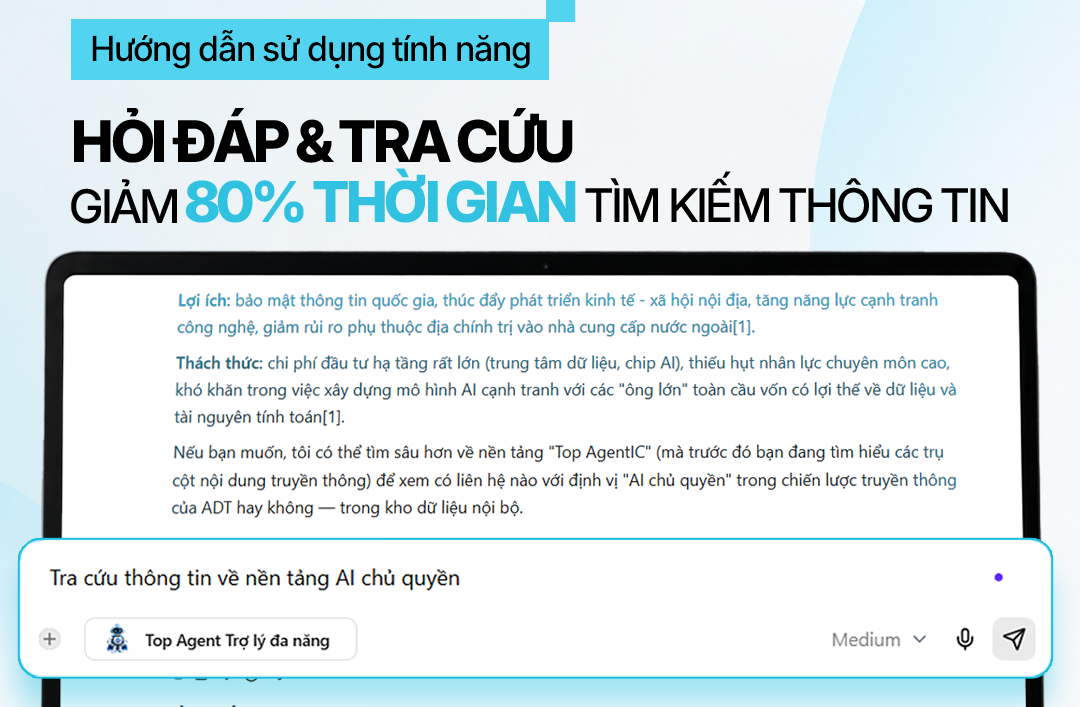
In day-to-day work, staff often have to switch constantly between search tools, email, stored documents, and business software just to find one piece of information. With its Q&A and Information Lookup feature, the TopAgent IC enterprise AI agent platform shortens this process by taking in the question, searching, cross-referencing, and compiling the result within a single interface.
This article explains how the enterprise AI assistant works, what problems the feature can solve, and the steps for using it on TopAgent IC.
1. What Is the Enterprise AI Assistant on TopAgent IC?
The enterprise AI assistant on TopAgent IC is a feature that lets users ask a question in natural language and receive an answer compiled from the information sources the system is permitted to access.
Instead of entering multiple keywords, opening each result, and piecing the information together by hand, users can simply describe what they want to know. TopAgent IC analyzes the request, searches for relevant data, compiles the content, and presents the result in the chat panel.
The feature can support needs such as:
Getting quick background on a topic or business issue.
Looking up current information from web sources the system supports.
Compiling key points from multiple sources.
Comparing information against specific criteria.
Suggesting related questions to continue researching.
Drawing on internal data once the user has selected the correct project and the corresponding document sources have been granted access.
What sets TopAgent IC apart from an ordinary Q&A chatbot is how it organizes its enterprise AI agents. Multiple agents can work together to handle different parts of the task, such as understanding the request, searching for data, cross-checking sources, and compiling the result.
This is an application of multi-agent AI to information lookup: the user focuses on the question and the result they need, while the system handles the intermediate steps behind the scenes.
2. Why Does Information Lookup Take Businesses So Much Time?
The information needed for a decision usually isn’t in one single place. Staff may have to search the web, check email, open project documents, or ask the person in charge before they have enough data to work with.
Some common bottlenecks include:
Information scattered across multiple tools
Documents can be in a personal drive, email, a chat group, Google Drive, or various internal software systems. Users have to remember where things are stored and keep switching between apps.
Search results lacking context
A general-purpose search tool may return many results, but they may not fit the business’s industry, time frame, or operational goal. Staff still have to read and filter through them manually.
Time spent compiling multiple sources
A question that feeds into a report or a business decision may require cross-referencing several sources. Manual copying, note-taking, and compiling easily disrupts the flow of work.
Dependence on experienced staff
New employees often have to ask colleagues where to find information or which document is currently in use. This slows down both the person asking and the person being asked.
Difficulty verifying AI-generated answers
If a result doesn’t show where the information was compiled from, users can’t judge its reliability and have no basis for checking it before using it.
Risk of exposing internal data to external tools
Using an AI tool outside the organization’s control can create risks around access permissions, where data is stored, and how it’s processed.
As a result, time that should go toward analysis and decision-making instead gets spent searching for, cross-referencing, and organizing information.
3. How Does TopAgent IC Support Q&A and Information Lookup?
TopAgent IC addresses the lookup process through four main functional layers.
3.1. Taking in questions in natural language
Users don’t need to construct a complex search syntax. A request can be phrased the way you’d normally delegate a task, including the goal, scope, time frame, and desired output format.
For example:
“Summarize the standout AI agent trends in 2026.”
“Compare three options and present them as a table.”
“Find information related to this regulation and cite the sources.”
“Summarize the issue into five key points for a report.”
3.2. Coordinating multiple AI agents
TopAgent IC can coordinate specialized AI agents to handle each part of a request. One agent might analyze the question, another searches for information, while another compiles the result in the appropriate format.
This mechanism reflects a defining feature of agentic AI: the system doesn’t just generate an instant answer, but can organize the necessary processing steps to fulfill the request.
3.3. Combining web sources with permissioned data
Depending on the feature and the access scope that’s been configured, the assistant can draw on information from the web or from data sources within the user’s project.
For in-depth searches within internal documents, users should select the correct project and use the Internal Document Search feature. This separation helps avoid mixing data between projects and keeps the lookup within the right context.
3.4. Presenting results that are easy to build on
After answering, the system can suggest related questions so the user can expand on or clarify the topic. This lets the research process flow continuously, rather than having to start over with each new query.
4. How to Use the Enterprise AI Assistant on TopAgent IC
Step 1: Clearly Define the Information You Need
Before entering a question, define:
The topic to look up.
The time range.
The relevant subject or industry.
The type of result you want to receive.
The desired presentation format.
The more specific the question, the better the system can determine the right scope to work within.
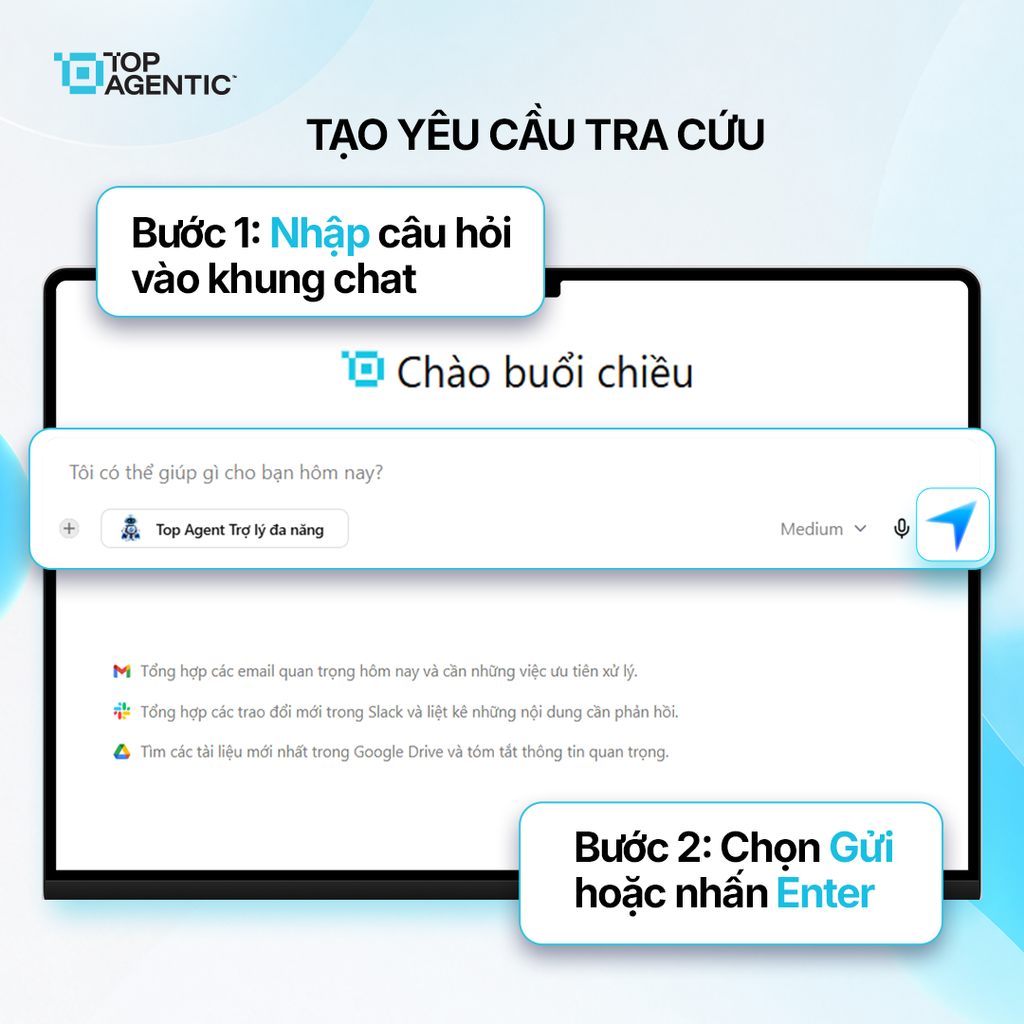
Step 2: Enter the Request in the Chat Panel
In the TopAgent IC interface:
Enter the question or topic you want to learn about in the chat panel.
Select Send or press Enter.
Wait for the system to analyze the request and return a result.
Instead of asking “What are the current AI trends?”, a user could write something more specific:
“List five AI agent trends for Vietnamese businesses in 2026, briefly explain the impact of each trend, and present them as a table.”
Step 3: Review the Result and Reference Sources
Once you receive an answer:
- Check whether the result matches the scope of the question.
- Review how recent the information is.
- Open the reference sources if the result will be used in a report or an important decision.
- Don’t use data that requires high accuracy directly without first cross-checking it against the original source.
The AI assistant shortens the process of finding and compiling information, but it doesn’t replace the user’s responsibility to verify it.
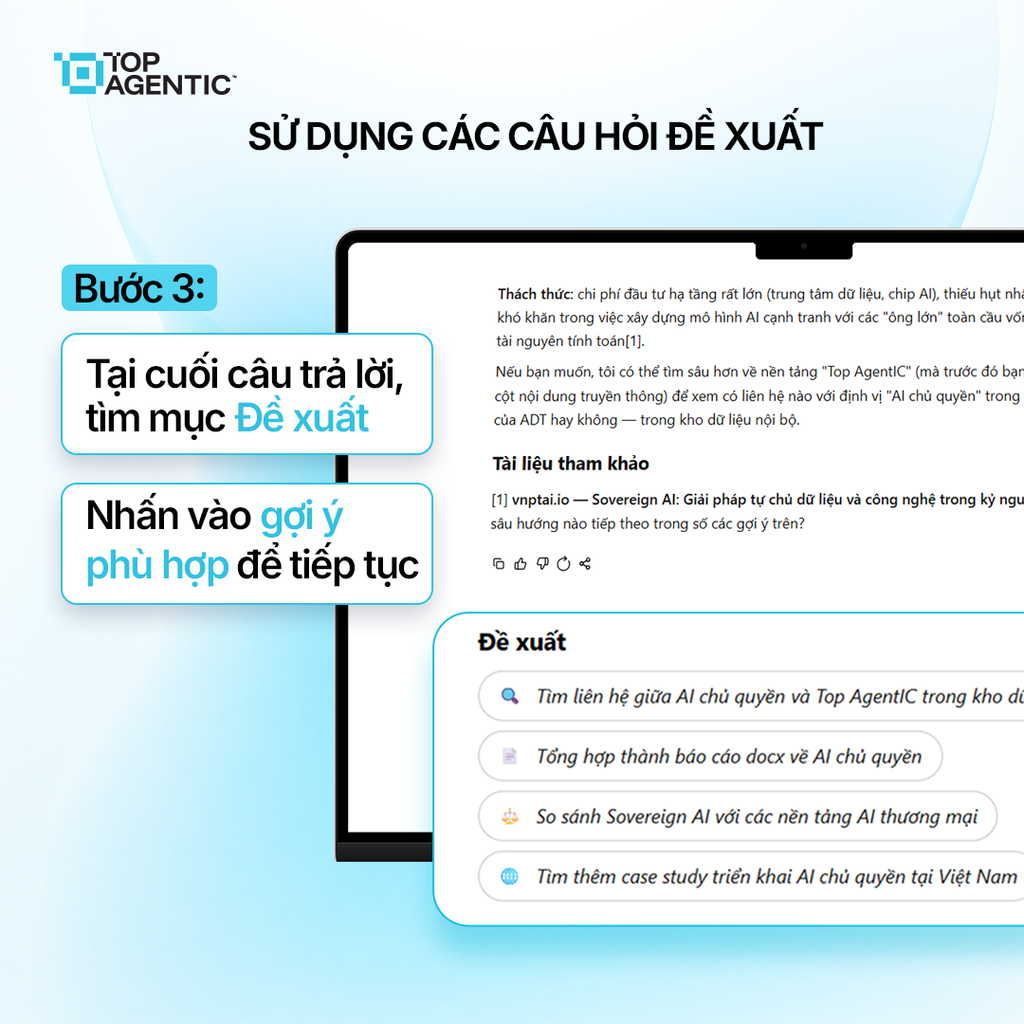
Step 4: Use Suggested Questions to Dig Deeper
After each answer, scroll down to the Suggestions section and select a relevant question to continue exploring.
Users can also add their own follow-up requests, for example:
- “Explain the third point in more detail.”
- “Only use sources from the past two years.”
- “Compare the results against three criteria.”
- “Turn this content into a table for a report.”
- “Summarize this in under 200 words.”
5. Why Should Vietnamese Businesses Use TopAgent IC?
Fits how organizations actually work
TopAgent IC is designed so teams can use AI within each project, data source, and specific scope of work, rather than relying on a standalone Q&A tool.
Supports building an internal AI agent ecosystem
The Q&A feature is part of an ecosystem made up of multiple specialized agents. Businesses can expand from information lookup into report generation, internal document search, and process automation.
Built toward data control
TopAgent IC supports a deployment model centered on sovereign AI, including on-premises or private cloud options based on the organization’s needs and infrastructure.
Optimized for the Vietnamese context
As a product developed by ADT Hi-tech, the platform is built toward handling Vietnamese language, business terminology, and the practical deployment needs of domestic organizations.
Conclusion
The enterprise AI assistant on TopAgent IC shortens the process from question to usable information. Instead of searching, reading, and compiling manually across multiple tools, users can delegate a request in the chat panel, receive a result, and continue digging deeper without breaking their flow of work.
The value of the feature isn’t in completely replacing human research, but in its ability to reduce intermediate steps, help people access information faster, and free up more time for evaluation, analysis, and decision-making.