Autonomous Robots in Smart Factories: From Standalone Devices to Integrated Operating Systems
The value of autonomous robots in smart factories appears when the devices are connected to the fleet manager, MES, WMS, ERP, and production data. At that point, the robots become part of an operational flow that can be coordinated, measured, and expanded.
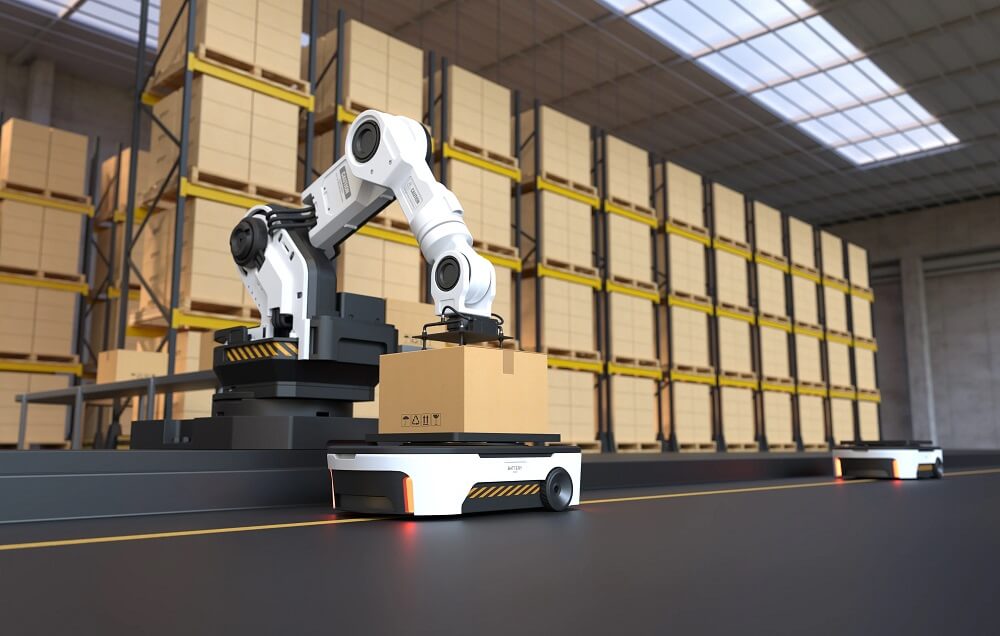
The value of autonomous robots in a smart factory emerges when the devices are connected to a fleet manager, MES, WMS, ERP, and production data. At that point, the robot becomes part of an operational flow that can be coordinated, measured, and scaled.
Autonomous robots are becoming the mobility infrastructure of the modern factory, from the component level to the movement of semi-finished goods. However, a robot that knows how to avoid obstacles doesn’t make a smart factory. The important shift is bringing standalone devices into an integrated operating system connected to the warehouse, production, and handoff points.
1. What Are Autonomous Robots in a Smart Factory?
An autonomous robot is a device capable of moving and carrying out transport or production-support tasks without a driver directly operating it. Two commonly encountered concepts are AGV and AMR.
- AGV (Automated Guided Vehicle): typically moves along predefined routes or guidance infrastructure.
- AMR (Autonomous Mobile Robot): uses sensors, maps, and positioning software to perceive its environment, choose a path, and adapt to changes within its design scope.
The IFR classifies AMRs as a type of professional service robot. In the context of industrial safety, ISO 3691-4:2023 covers driverless industrial trucks and their systems, including equipment commonly referred to as AGVs or AMRs.
The key point is how deeply the robot participates in the shared process. A device that navigates well but doesn’t exchange data with production is still an “island of automation.”
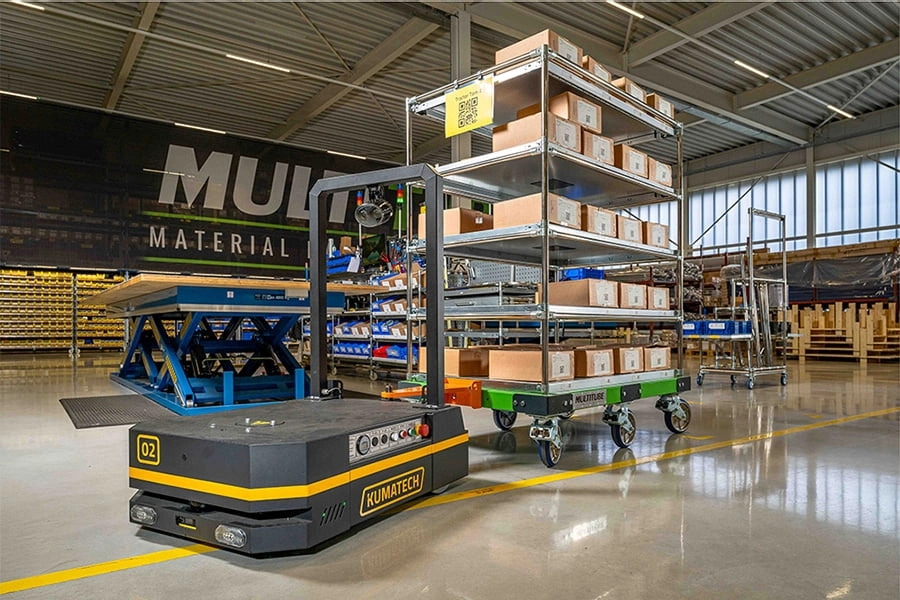
2. How Do AGVs and AMRs Differ?
| Criteria | AGV | AMR |
|---|---|---|
| How it moves | Follows a preset route or guidance method | Localizes itself and plans its own path within the operating area |
| Response to obstacles | Usually stops or waits for the route to clear | Can find an alternative path if configuration and conditions allow |
| Layout changes | May require adjusting the guidance infrastructure | Usually more flexible when maps and rules are updated |
| Best-fit problems | Stable, repetitive flows with little variation | Changing environments, many pick-up/drop-off points, and dynamic flows |
| Deployment complexity | Focuses on routes, stopping points, and equipment communication | Adds a focus on maps, traffic, data, and robot fleet coordination |
The table is for orientation only, since many products combine characteristics of both groups. AGVs suit stable flows; AMRs in a factory are typically more flexible when the environment changes. The choice should be based on the problem to be solved, safety, and total cost of ownership.
3. Why Doesn’t a Standalone Robot Make a Smart Factory?
A robot may run well between two points but run into problems as the number of tasks and intersections grows:
Manually assigned tasks don’t follow the production plan.
Multiple robots choose the same aisle and cause congestion.
Robots have to wait because the receiving station isn’t ready.
The warehouse can’t update the status of pallets.
Robots from different vendors use different software.
In that case, each robot’s efficiency may be good, but the overall line’s efficiency remains low because of the lack of connection among devices, people, and IT/OT systems.
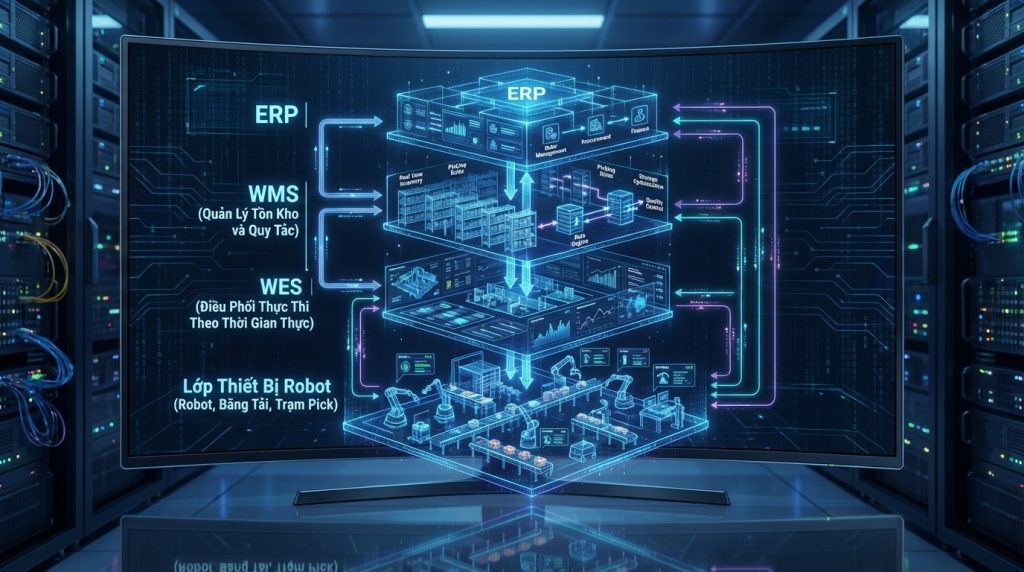
4. Architecture of an Integrated Autonomous Robot Operating System
Robots and endpoint equipment: AMRs, AGVs, autonomous forklifts, or mobile manipulators communicate with doors, conveyors, charging stations, production machines, and pick-up/drop-off points.
Fleet manager: allocates tasks, manages traffic, monitors battery levels, and sets priorities to optimize the overall flow rather than each robot individually.
MES, WMS, ERP, and PLC/SCADA: provide warehouse requests, production plans, orders, and machine status. Siemens treats fleet integration as the problem of coordinating multi-vendor AGVs/AMRs while connecting them to MES, ERP, and WMS.
Data and AI: aggregate robot status, queues, and production conditions to support demand forecasting, anomaly detection, or allocation recommendations.
Safety and governance: includes operating zones, aisles, intersections, loads, speed, and incident-handling procedures, not just the sensors on the robot.
For a multi-vendor robot fleet, interoperability is especially important. VDA 5050 provides a communication interface between mobile robots and a central control system, aiming to standardize connectivity.
5. Use Cases for Autonomous Robots in Factories
Material supply: moving components from the warehouse to the production line.
Semi-finished goods transfer: connecting production stages without fixed conveyors.
Pallet transport: autonomous forklifts handle pallets in receiving and dispatch areas.
Inspection: mobile robots carry cameras or sensors to the locations that need to be observed.
Mobile manipulators: a mobile platform combined with a robotic arm to pick, place, or assemble.
The IFR notes that mobile manipulators are being introduced into warehouses and manufacturing facilities for material transport, quality inspection, and flexible assembly.
6. Benefits of Moving from Standalone Devices to an Integrated System
Synchronized production: tasks are triggered by actual demand.
Flexible scaling: add new robots, handoff points, or routes.
Reduced waiting time: the fleet manager coordinates based on overall status.
Better traceability: records the robot, materials, origin and destination, and timing.
Continuous improvement: data helps identify operational bottlenecks.
The IFR’s World Robotics 2025 reports that 542,000 industrial robots were installed worldwide in 2024. This isn’t a figure specific to AMRs, but it reflects the continuing expansion of investment in automation.
7. Common Bottlenecks When Deploying AMRs and AGVs
Choosing the robot before defining the problem: the device runs, but it doesn’t solve the actual material bottleneck.
Only optimizing the route: the robot moves quickly but still has to wait for machines, doors, staff, or pallets.
Lack of connectivity standards: each expansion creates its own integration layer and raises maintenance costs.
Not surveying the environment: network, floor, aisles, lighting, dust, and intersections all affect the robot.
Lack of exception handling: unclear response when the network drops, the battery runs out, a handoff point is busy, or the robot hits a fault.
8. Roadmap for Deploying an Autonomous Robot System
Choose the transport flow: prioritize processes that are repetitive, have clear pick-up and drop-off points, and are easy to measure.
Survey the environment: assess the layout, payload, aisles, intersections, charging stations, network, and interaction with people.
Design the integration: determine which system creates tasks, how the fleet manager coordinates, and where data is recorded.
Pilot with KPIs: track completion rate, cycle time, intervention rate, waiting time, empty-travel distance, and safety incidents.
Standardize, then scale: finalize exception handling, operating permissions, and training before increasing the number of robots.
9. From Fleet Management to Smart Factory-Wide Coordination
When robot data connects with production, warehouse, energy, and maintenance, the system can coordinate around shared goals: prioritizing orders, balancing capacity, and limiting congestion. AI is well suited to the role of analyzing context, recommending options, and coordinating tasks within established safety boundaries. This is the shift from AMR autonomous robots to a Physical AI ecosystem operating in sync.
Conclusion
Autonomous robots in a smart factory only deliver their full value when they’re treated as part of an operating system, not as a device bought to run on its own. Robots need to connect with the fleet manager, MES, WMS, ERP, machinery, data, and safety procedures.
Businesses should start from a specific material flow, measure it with operational KPIs, and design for integration from the very beginning. When the connectivity infrastructure is solid enough, robots don’t just move goods; they become a link that can be coordinated across the entire factory.
Frequently Asked Questions (FAQ)
What are autonomous robots in a smart factory?
They are driverless robots such as AGVs or AMRs, used for transport, production support, or inspection in a factory. When integrated with a fleet manager and production systems, the robot becomes part of the shared operating flow.
How do AGVs and AMRs differ?
AGVs typically operate along preset routes or guidance methods; AMRs can localize and plan paths more flexibly. The choice depends on layout, degree of variability, and operational requirements.
What role does a fleet manager play?
A fleet manager allocates tasks, manages traffic, monitors status, and coordinates charging for the robot fleet. The system helps optimize overall flow rather than each robot individually.
Which safety standards relate to AGVs and AMRs?
ISO 3691-4:2023 sets out safety requirements and verification methods for driverless industrial trucks and their systems.