What is Physical AI? Its applications in service robots
Physical AI helps robots perceive their environment, analyze situations, and act in the real world, opening up many service applications for businesses.
Physical AI helps robots perceive their environment, analyze situations, and act in the real world, opening up many service applications for businesses.
Service robots are moving from fixed command sequences toward better awareness and adaptability. Physical AI helps explain this shift.
Physical AI helps robots and autonomous machines sense, reason, and act in the physical world. For service robots, the technology supports navigation, recognition, communication, and task execution. Effectiveness depends on hardware, data, environment, safety, and oversight.
What is Physical AI?
Physical AI is the layer of intelligence that helps a system perceive, reason, and act in a physical environment. The system must handle distance, collisions, obstacles, people, and unpredictable changes.
NVIDIA defines Physical AI as technology that enables autonomous machines to perceive, understand, and perform complex actions in the real world. Such systems can include robots, autonomous vehicles, and smart cameras.
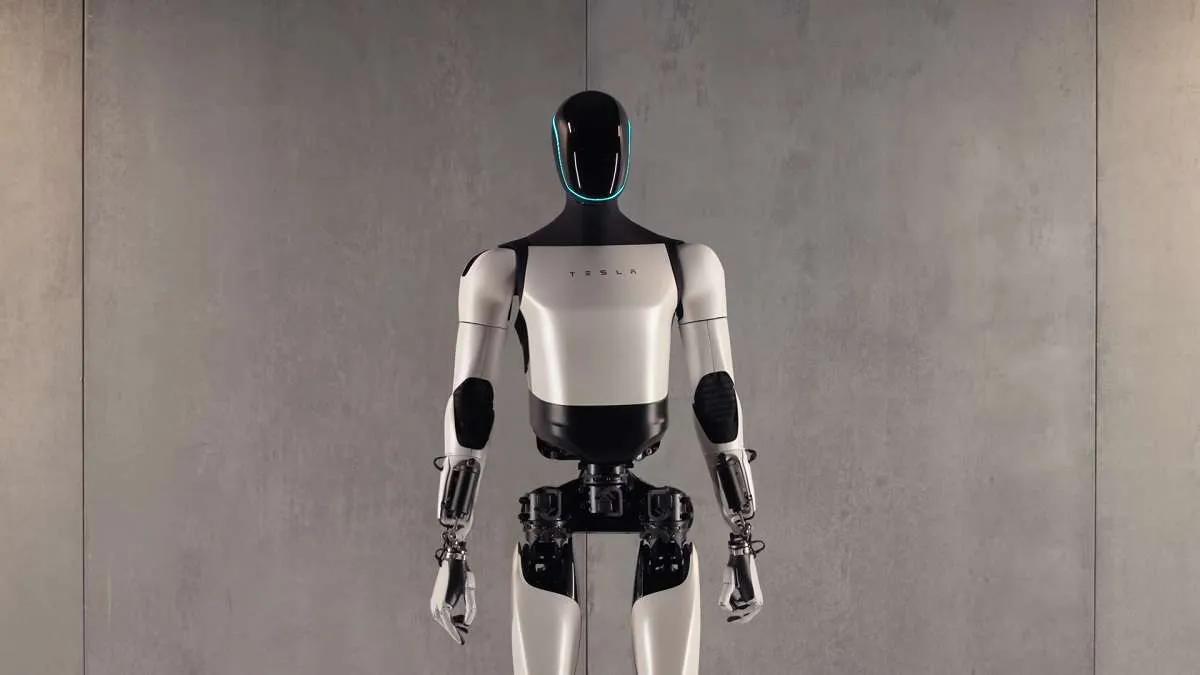
Physical AI is not a type of robot. Humanoid robots, AMRs (autonomous mobile robots), delivery robots, and robotic arms can all apply the technology to different degrees.
How Physical AI differs from generative AI and traditional automation
Generative AI mainly creates digital content. Physical AI can use generative models, but its output usually involves action in physical space.
Traditional automation suits stable environments and predefined processes. Physical AI aims to handle variability: detecting obstacles, understanding commands, changing routes, or choosing actions based on the situation.
| Criteria | Generative AI | Traditional automation | Physical AI |
|---|---|---|---|
| Environment | Digital data | Structured space | Changing physical world |
| Input | Text, images, audio | Signals and rules | Sensors, data, commands |
| Output | Digital content | Pre-programmed actions | Decisions and physical actions |
| Adaptability | Based on data context | Often limited | Can adjust to the environment |
| Main risk | Incorrect content | Cycle errors | Collisions, wrong actions, disruptions |
Modern robots can combine safety rules, generative AI for communication, and Physical AI for perception and navigation.
How does Physical AI architecture work?
Physical AI typically operates in a loop:
- Sense: cameras, LiDAR, depth, ultrasonic, or force sensors capture the current state.
- Localize: identify people, objects, obstacles, and the robot’s own position.
- Plan: interpret the goal, choose actions, and check constraints.
- Act: control wheels, arms, grippers, or interfaces within permitted limits.
- Feedback: measure results, update the plan, slow down, or stop when needed.
Simulation can support training before deployment. NVIDIA’s Physical AI Learning materials cover data, digital twins, simulation, policy training, and real-time deployment. Results still need to be tested in the real world.
What is a service robot?
According to the International Federation of Robotics, a service robot is a robot used for personal or professional purposes to perform tasks useful to humans or equipment. The definition does not depend on the robot’s shape.
Service robots operate in hotels, hospitals, airports, offices, or public areas. Environments with people moving around require safety and predictable behavior.
7 Applications of Physical AI in Service Robots
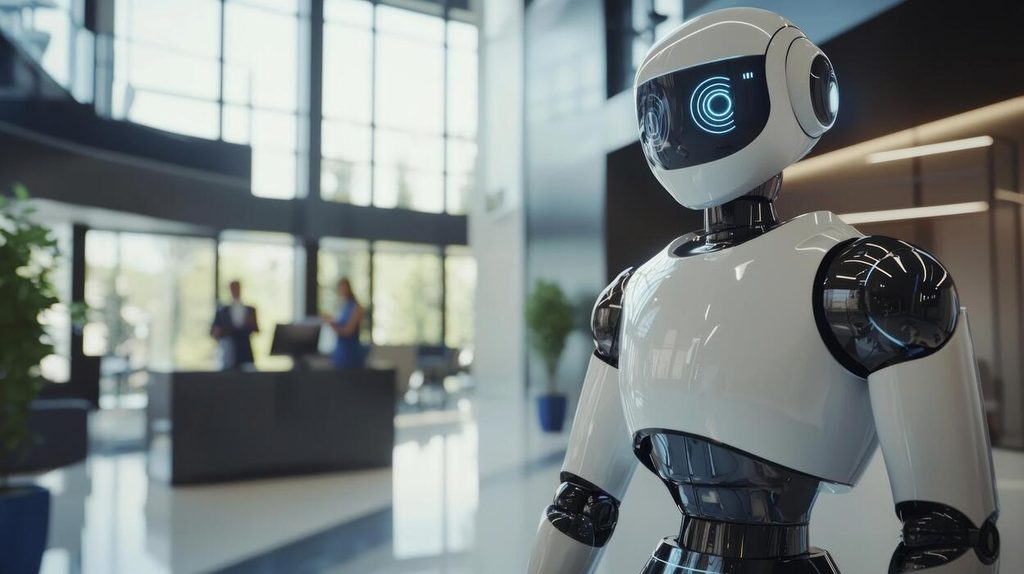
- Receptionist robots: greet visitors, take questions, give directions, and introduce services.
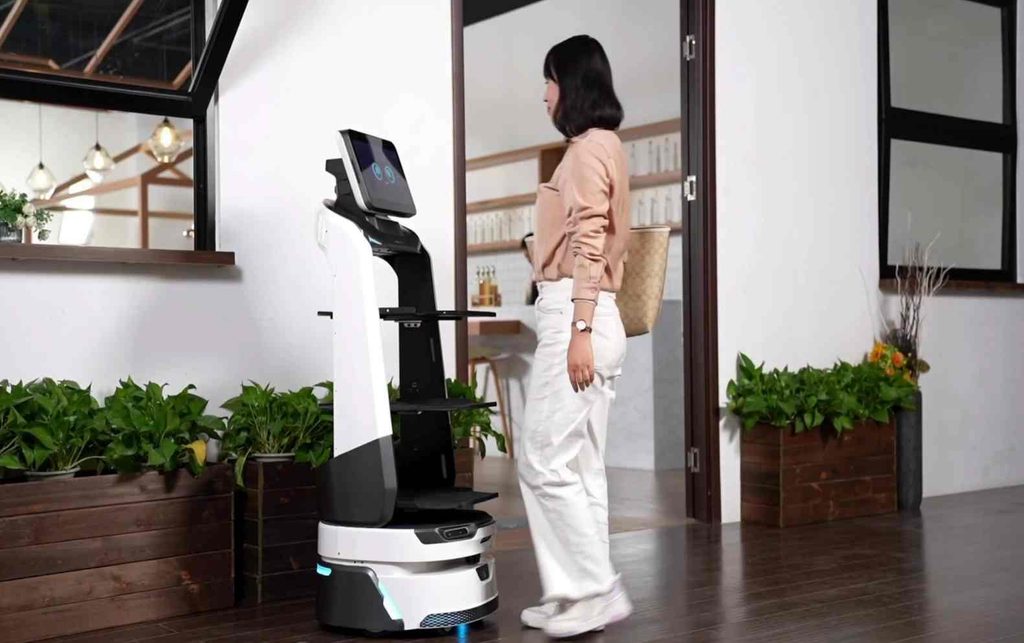
- Delivery robots: transport documents, items, or meals between points.
- Cleaning robots: recognize areas, plan routes, and adjust to floor conditions.
- Patrol robots: observe routes, detect signs of anomalies, and send alerts.
- Retail robots: guide customers, introduce products, or check shelves.
- Medical robots: transport supplies, assist with disinfection, or provide guidance.
- Event robots: create interactive touchpoints, guide visitors, and connect content.
Each application needs its own data, operating zone, and supporting processes. Robots should not draw conclusions about incidents, make diagnoses, or make decisions beyond their approved scope.
Benefits of Physical AI for Businesses
- Adaptability: responds to change instead of only running fixed commands.
- Task expansion: can be configured for multiple areas or situations.
- Greater interaction: uses natural language, screens, and recognition.
- Data generation: records status, time, errors, and interventions.
- Support for repetitive work: staff focus on handling exceptions.
Benefits must be measured in real workflows. A robot that performs well in a demo is not necessarily effective if it lacks data, an operational owner, or frequently needs assistance.
Challenges and Risks to Manage
Lighting, noise, floor surfaces, obstacles, networks, and human behavior all affect robots. Errors can cause collisions or service disruptions.
Businesses should pay attention to:
- Limits on zones, speed, and permitted types of action.
- Emergency stop mechanisms and switching to manual control.
- Access permissions for cameras, microphones, and operational data.
- Testing edge cases such as network loss, power loss, or blocked sensors.
- Maintenance of hardware, batteries, wheels, and sensors.
- Responsibility for handling cases where the robot fails to complete a task.
Flexible reasoning should not replace deterministic safety layers. Actions affecting people or property must have appropriate limits.
Checklist for Deploying Service Robots with Physical AI
- Choose the problem: define the task, frequency, distance, payload, and performance metrics.
- Survey: measure corridors, slopes, doors, elevators, floor surfaces, lighting, and connectivity.
- Set the level of autonomy: clarify what the robot handles itself and when it must call staff.
- Check integration: identify connections to CRM, buildings, warehouses, maps, or AI platforms.
- Pilot: measure completion rate, time, number of interventions, and user feedback.
- Prepare operations: assign responsibilities, charging schedules, cleaning, updates, maintenance, and backup plans.
Expand only when the robot meets the agreed criteria in the pilot area.
Physical AI and the Robotics Ecosystem in Vietnamese Businesses
Vietnamese businesses should start with a clear task, connect the necessary data, and then build a monitoring and coordination layer. Not every robot needs high autonomy.
ADT Global’s approach is to combine devices, content, and AI platforms according to each problem. Contact ADT Global to build a roadmap for applying Physical AI in service and operations spaces.
Conclusion
Physical AI brings the ability to perceive, reason, and act into the real world. In service robots, the technology supports navigation, interaction, and adaptation, but it does not remove safety requirements. Businesses should pilot within a controlled scope and measure effectiveness with data.
Frequently Asked Questions
What is Physical AI?
Physical AI is AI that enables a system to perceive, reason, and take action in a physical environment.
Is Physical AI the same as a robot?
No. A robot is a physical device; Physical AI is an intelligence layer that can be integrated into robots and autonomous machines.
Do service robots need an internet connection?
It depends on the architecture. Some functions run on the device; data or coordination functions may need a network. A safe mode is needed for when connectivity is lost.
Can Physical AI replace staff on its own?
The technology is suited to supporting repetitive or standardizable tasks. People are still needed to manage exceptions, supervise, and take responsibility for important decisions.
Where should a business start deploying?
Choose one task with clear measurable criteria, survey the environment, pilot on a small scale, and evaluate before expanding.