3D OOH: Making people remember your brand in just 3 seconds
As static advertising gradually loses its appeal, 3D billboards (3D OOH) are creating a visual revolution, helping brands make a strong impression in just 3 seconds.
3D OOH (Out-of-Home Advertising) is transforming the outdoor advertising landscape as static formats gradually lose their appeal. By creating striking visual illusions, 3D billboards help brands capture attention within the first three seconds. However, implementing these campaigns in Vietnam requires specialized technical expertise and an end-to-end execution strategy. Discover the latest trends and effective solutions for 3D OOH in this article.
1. 3D OOH Billboards: A Breakthrough in Modern Outdoor Advertising
1.1. What Is a 3D OOH Billboard?
A 3D OOH billboard is an outdoor advertising format that uses naked-eye 3D technology and anamorphic techniques on curved or L-shaped LED screens to create the illusion of objects extending beyond the screen, without requiring viewers to wear special glasses.
1.2. A Booming Market in Numbers
For years, out-of-home (OOH) advertising primarily relied on static formats, such as Hiflex banners, or 2D videos displayed on digital out-of-home (DOOH) screens. However, the landscape is changing rapidly. According to the latest market report from Fortune Business Insights, updated through Q3 2026, the global DOOH market is experiencing strong growth and is projected to reach USD 56.1 billion by 2034, with an impressive compound annual growth rate (CAGR) of 12.09% from 2026 onward.
In particular, the rise of digital out-of-home advertising (DOOH) combines the flexibility of digital platforms with the broad reach of traditional OOH, opening up a new frontier for advertising. This significant shift is driven by the visual impact of anamorphic effects (naked-eye 3D). By manipulating perspective and calculating the optimal viewing angle, known as the sweet spot, this technology creates an optical illusion that makes objects appear to leap out of massive screens, capturing the attention of passersby and helping them remember a brand within the first three seconds.
Beyond visual 3D experiences, the DOOH market is also witnessing the emergence of interactive DOOH powered by AI and Physical AI. This trend creates new opportunities for brands to move beyond visual impact and deliver two-way experiences with audiences.
1.3. The Real Business Value of 3D OOH Campaigns
Investing in 3D advertising billboards is not merely a short-term expense. It can be a long-term brand-building strategy that delivers several tangible benefits:
- Stronger brand recall compared with conventional 2D advertising: Research into consumer behavior and OOH advertising suggests that the human brain prioritizes visual information involving movement, spatial relationships, and depth. Compared with conventional 2D advertising, naked-eye 3D can increase attention and message recall, potentially improving return on investment (ROI).
- Earned media and cross-platform virality (O2O): An impressive 3D billboard at a busy intersection can quickly become a popular check-in spot. Viewers film the experience and share it on TikTok, Facebook, and Instagram Reels, generating substantial earned media exposure and organic word-of-mouth without additional media spending.
- Stronger brand positioning and differentiation: Being an early adopter of 3D technology demonstrates a company’s technological capabilities, investment capacity, and commitment to innovation, helping it stand out from competitors.
2. ADT: A Pioneer in 3D OOH Advertising in Vietnam
2.1. Pioneering the Domestic Market
Behind a seamless 3D advertising billboard are hundreds of hours of technical calculations involving pixel pitch, surface contrast, and actual viewing distance. ADT takes pride in being the first company to lay the groundwork for and successfully implement 3D OOH billboards in Vietnam.
Addressing challenges specific to Vietnam’s infrastructure — including variations in LED pixel pitch, limitations in building corner geometry, and intense tropical sunlight that reduces image contrast — ADT’s R&D team has continuously tested and standardized rendering techniques. The team optimizes every visual illusion to deliver sharp, smooth, and realistic imagery on existing domestic display infrastructure.
2.2. End-to-End Solutions: Optimizing Time and Cost While Minimizing Risks
One of the biggest pain points for brands implementing 3D advertising billboard campaigns is the fragmentation of service providers. Clients often need to hire a Creative Agency to develop the concept and script, a 3D Studio to produce the video, and a Media Agency to book LED screen placements.
This fragmented approach can lead to communication and execution issues. A 3D video may look spectacular on a computer but appear distorted when displayed on the actual screen due to incorrect perspective, warped imagery, pixelation, or a complete failure to achieve the intended 3D illusion from the audience’s viewing position.
To address these risks, ADT offers an end-to-end 3D OOH production solution, taking responsibility throughout the campaign lifecycle:
- Ideation: Develop creative concepts aligned with marketing objectives, creating a cohesive storyline tailored to each brand and its display environment.
- Production: Handle design, 3D modeling, material creation, and animation.
- Airing: Advise on strategic LED screen locations, perform technical calibration and mapping, and supervise on-site display quality.
- Integrated Marketing Communications (IMC): Develop a multichannel amplification strategy to maximize campaign impact, turning on-site experiences into shareable content across digital platforms.
3. Four Essential Tips for Brands Planning a 3D OOH Campaign
To achieve campaign success and optimize budgets, brands should consider four critical factors:
1. Choose the right LED screen: Not every outdoor LED screen is suitable for 3D advertising. Ideal options include L-shaped screens with a 90-degree corner or curved LED displays. High resolution is essential for smooth imagery and effective viewing from the intended audience positions.
2. Select the right location: Choose a location with high footfall or traffic volume and sufficient viewing space to establish the optimal 3D sweet spot. Strategically, the right location can transform a conventional physical viewing experience into a social stunt that encourages audiences to film and share the display, generating organic conversations and extending brand awareness across digital channels.
3. Optimize video duration: A 3D OOH video should generally last 15–30 seconds. This duration is often sufficient to capture the attention of commuters, including those waiting at traffic lights, while delivering the message without losing their interest. Messaging should be direct, typography should be large, and unnecessary visual details should be minimized.
4. Integrate cross-channel calls to action (CTAs): Turn attention into engagement and conversion. Adding a prominent QR code at the end of the video, combined with Facebook Page mini-games that encourage users to check in with the 3D billboard, can create an effective O2O (offline-to-online) engagement loop.
4. Case Studies: Notable 3D OOH Projects by ADT
ADT has applied these principles across several real-world projects in Vietnam.
4.1. TV360 — Vietnam’s First 3D Advertising Billboard
A common “weak point” of 3D billboards is that customers tend to remember the unique viewing experience rather than the content the brand is conveying. ADT solved this problem in the campaign celebrating the 1-year anniversary of the TV360 app launch during the lively atmosphere of the 2021 AFF Cup season.
Appearing on a 3D billboard at the Pham Ngoc Thach – Nguyen Thi Minh Khai intersection, the TVC impresses with actor Sy Hung appearing and interacting with viewers. By combining the visual effects advantage of 3D billboards with breakthrough movements like the character waving at viewers, football flying off the screen, etc., TV360’s TVC recreates the authentic feeling of experiencing the app without using any words to describe it.
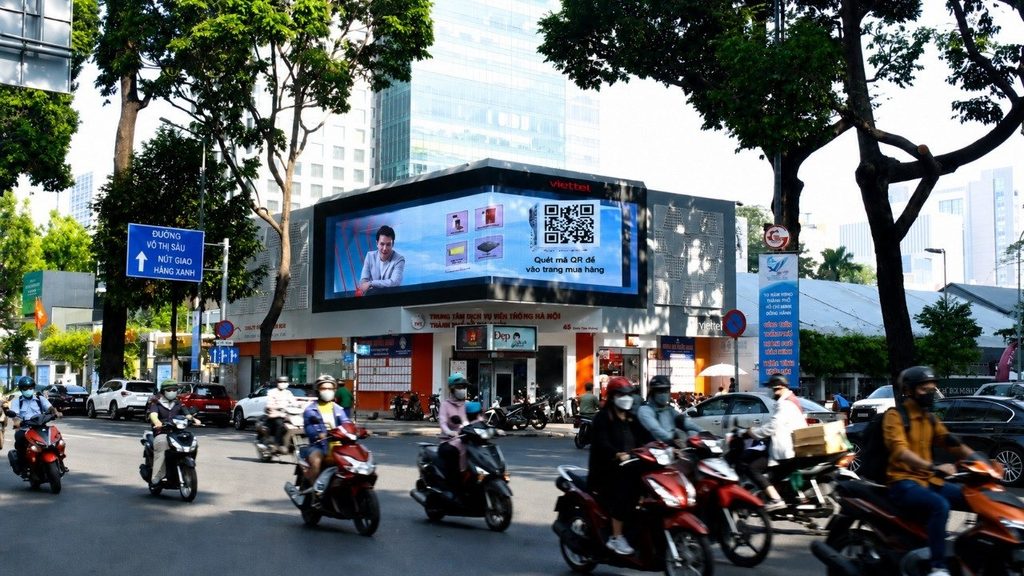
Besides the visual aspect, the content is designed with a QR code at the end of the video to guide viewers to take action and download the app. The campaign aims to balance visual effects with specific digital conversion goals.
4.2. VPBank – ‘Breakthrough from Today’ shines brightly in the heart of the Capital
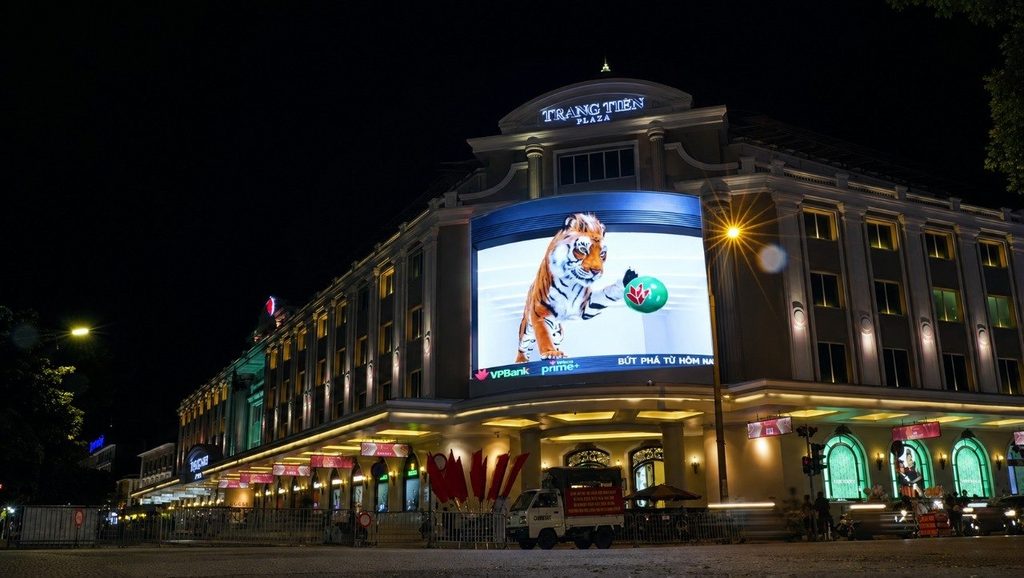
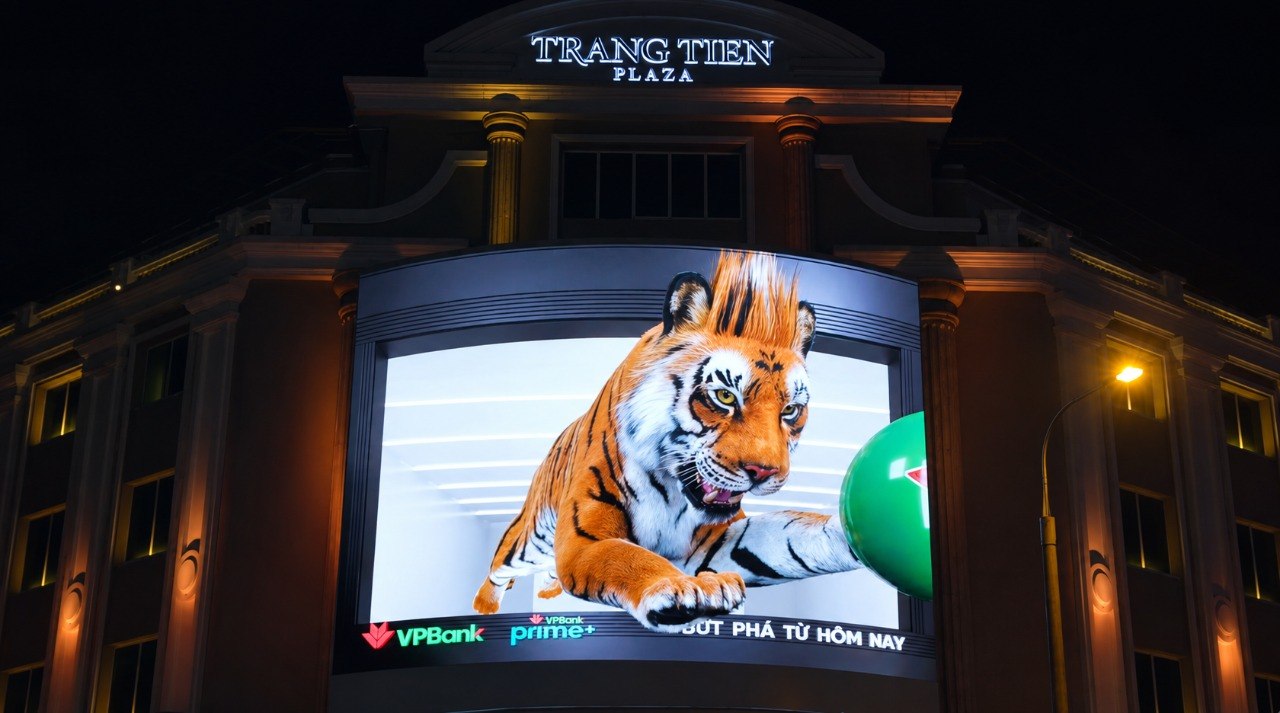
In 2022, as part of its brand repositioning campaign, VPBank together with ADT launched a standout 3D OOH project at Hang Bai Intersection (Trang Tien Plaza) – one of the busiest crossroads in Hanoi.
Featuring a modern tiger (the zodiac animal of 2022) playing with a ball bearing the VPBank logo, the naked-eye 3D effect created the illusion of the mighty tiger pouncing, “leaping out of the giant screen” down onto the street. This well-planned investment drew thousands of check-ins and strongly spread the spirit of breakthrough to the Gen Z audience, cementing the bank’s position as a leading private bank.
4.3. Viettel Telecom – Visualizing telecom messages with the *098# syntax
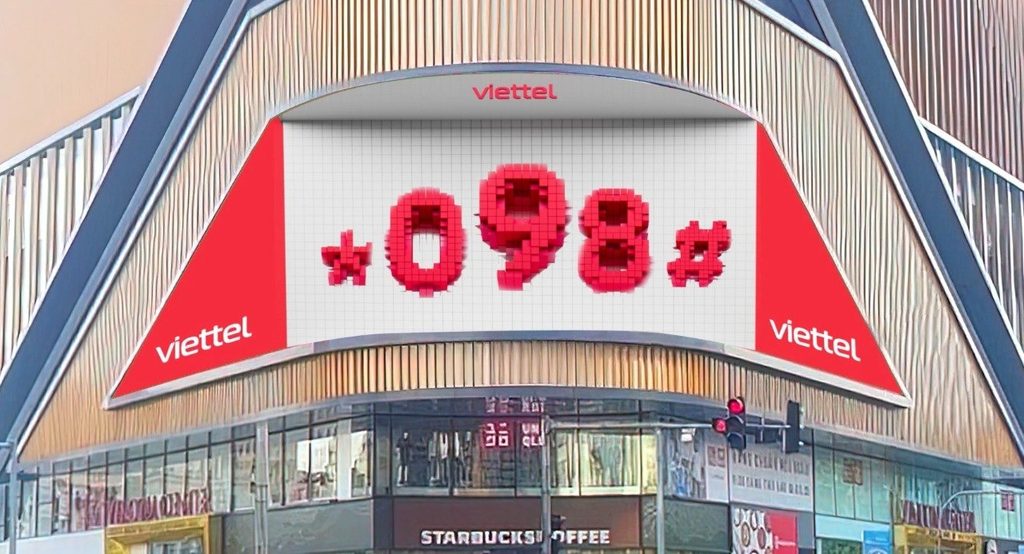
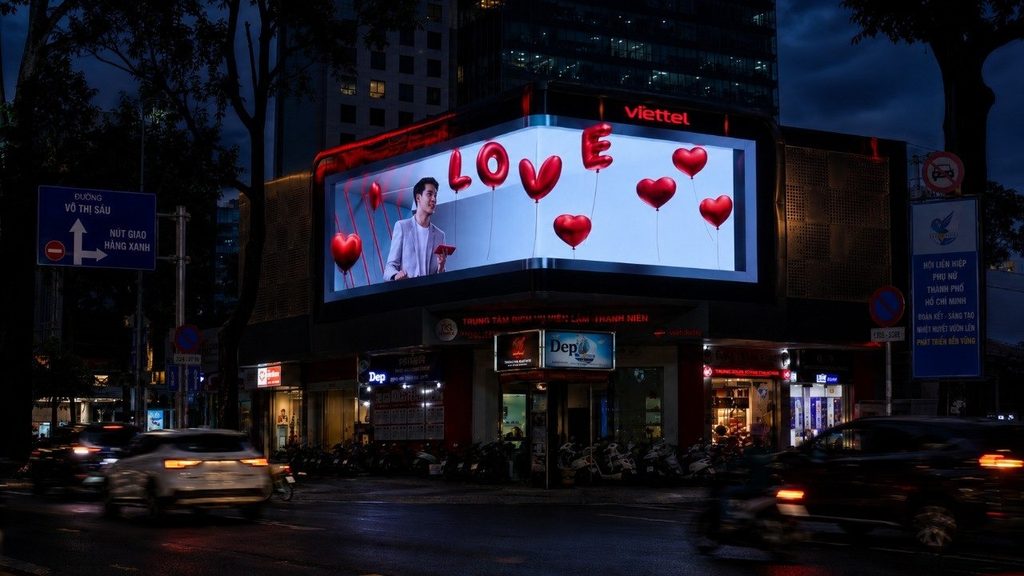
In the campaign promoting the *098# syntax, Viettel and ADT turned the service message into a dynamic visual experience on 3D OOH screens. The video content simulates breaking through solid blocks, symbolizing connection barriers, using images of giant hands and mobile devices displaying the *098# syntax.
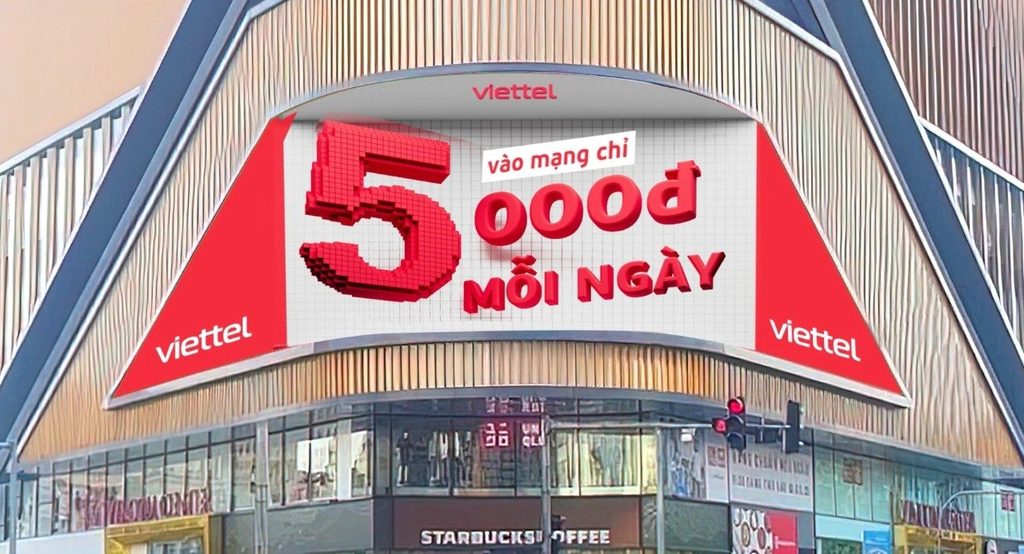
The use of highly metaphorical imagery, combined with the distinctive depth effects of 3D OOH, enabled Viettel to communicate its message of proactivity and unlimited connectivity in a visually compelling way, creating a strong impression on viewers in the advertising area.
In today’s information-saturated era, capturing the attention of target customers within the first few seconds is a core challenge for every communications campaign. To address this challenge, marketing professionals need a clear understanding of what 3D OOH is and how this next generation of digital out-of-home advertising works. Combining prominent visual effects with 360-degree projection technology helps transcend the limitations of physical space, maximize brand message recall at the first point of contact, and establish a distinct competitive advantage.
As OOH campaigns expand from large-scale outdoor environments into indoor event spaces, designing a seamless digital experience journey remains essential to elevating brand positioning. By deploying interactive event display systems, businesses can transform complex data flows into information that is easy to understand. Furthermore, when seamlessly integrated with immersive interactive software, this ecosystem empowers guests to navigate their own experiences, turning them from passive observers into the center of the entire brand story.
5. Conclusion
Market statistics and real-world projects demonstrate that 3D OOH advertising is not merely an “upgrade” to 2D advertising, but a format that is shaping the future of advertising. By delivering immersive, multidimensional experiences, it helps brands bridge the gap with audiences, engage them meaningfully, and capture their attention in a more natural and compelling way.
With end-to-end capabilities spanning strategic consultation through execution, backed by extensive experience across a wide range of projects, ADT is proud to be a trusted strategic partner, ready to turn your most innovative ideas into reality through 3D billboard advertising.
Ready to take your brand beyond the screen?
Contact ADT today to create impactful and memorable advertising campaigns!