Comparing VR, AR, MR, and XR: How are they different?
VR, AR, MR, and XR are not four names for one solution. Each concept describes a different degree of blending between the real world and digital content. This article compares VR, AR, MR, and XR to help businesses choose the right technology for events, training, and operations.
VR, AR, MR, and XR are not four names for one solution. Each concept describes a different degree of blending between the real world and digital content. This article compares VR, AR, MR, and XR to help businesses choose the right technology for events, training, and operations.
TL;DR: VR replaces the real environment with a virtual space. AR overlays digital content on the real world. MR lets digital objects interact more deeply with the physical space. XR is the umbrella term covering VR, AR, and MR. Because the boundary between AR and MR can shift, businesses should evaluate real capabilities rather than labels.
What is XR, and why does it include VR, AR, and MR?
XR stands for Extended Reality, an umbrella term for experiences that combine the physical and digital environments. XR does not refer to a single type of headset. A project can run on VR headsets, see-through glasses, phones, or projection systems. The Khronos Group describes OpenXR as an open API standard for XR applications across many AR and VR devices.
On a spectrum, AR is closer to the physical world, VR is closer to the digital environment, and MR blends the two more deeply.
What is VR?
VR (Virtual Reality) places users in a digital environment, blocking most or all of their real view. Users typically wear a headset and interact with controllers, hand tracking, or their bodies.
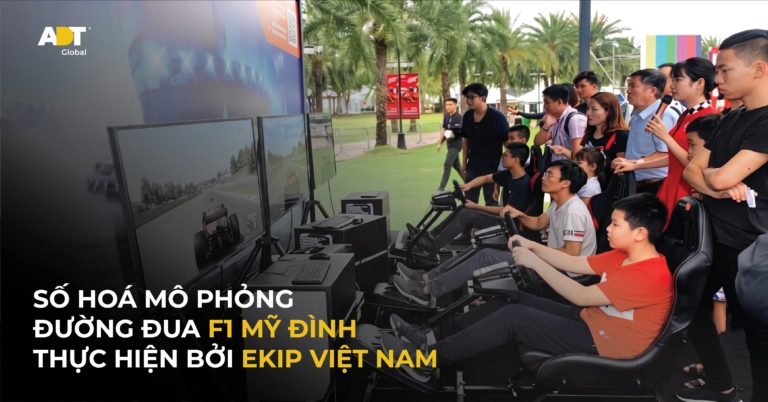
VR offers a high level of immersion and suits simulations of factories, construction sites, products not yet built, or settings that are hard to bring to an event.
VR requires device management, headset cleaning, a movement area, and staff to guide users. Some people may experience eye strain or dizziness, so session length should be controlled.
What is AR?
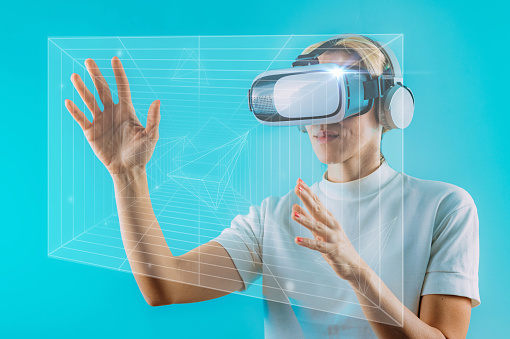
AR (Augmented Reality) adds digital images or objects to a real scene through a phone, tablet, or see-through device.
AR is easy to access because it can use mobile devices. Customers can scan a product, view information, or place a 3D model in their space.
To keep digital objects stable, the system needs to track motion and the environment. Google’s ARCore documentation describes motion tracking, plane detection, depth, and light estimation. Not every AR application uses all of these capabilities.
AR is limited by screen size, performance, lighting, and the need to hold up a phone. A fallback is needed for incompatible devices.
What is MR?
MR (Mixed Reality) combines the physical and digital environments so that objects can be anchored to and respond to the real space. The system can recognize surfaces, boundaries, and the user’s position.
Microsoft defines mixed reality as a blend of the physical and digital worlds, built on computer vision, graphics, displays, and input systems. The documentation places AR and VR within a broad spectrum; some vendors use “MR” in a narrower sense.
An example of MR is a virtual machine model anchored on a table, holding its position as the user moves and being realistically hidden behind real objects. The technology suits technical instruction and collaborative design.
MR usually requires more specialized devices and development than AR. Ask for a description of spatial mapping, occlusion, tracking, and interaction rather than relying only on the “MR” label.
Comparison Table: VR, AR, MR, and XR
| Criteria | VR | AR | MR | XR |
|---|---|---|---|---|
| Full name | Virtual Reality | Augmented Reality | Mixed Reality | Extended Reality |
| Real environment | Mostly replaced | Still visible | Blended with digital content | Covers multiple degrees |
| Devices | VR headsets, controllers | Phones, tablets, AR glasses | MR headsets or devices with spatial sensors | Depends on the type of experience |
| Spatial understanding | May be limited to the virtual environment | From basic to advanced | Usually a core capability | Not fixed |
| Level of immersion | High | Low to medium | Medium to high | Depends on the technology |
| User scale | Usually one person at a time | Easy to scale through phones | Depends on specialized devices | Not fixed |
| Notable applications | Simulation, training, virtual tours | Marketing, product try-on, guidance | Design, maintenance, 3D collaboration | A strategy or ecosystem of solutions |
How do AR and MR differ?
The boundary between AR and MR is not standardized. Filters or images overlaid on a camera feed are usually AR. When content recognizes surfaces, holds its position, is realistically occluded, and responds to the environment, the experience is usually called MR or advanced spatial AR.
Instead of debating labels, ask:
- Is the digital object stably anchored in space?
- Does the system understand physical surfaces and boundaries?
- Does the content interact with hands, eyes, the body, or real objects?
- On which devices and under what conditions does the experience run?
The answers help produce a more accurate estimate than the label used in a proposal.
Applications of VR, AR, MR, and XR in Business
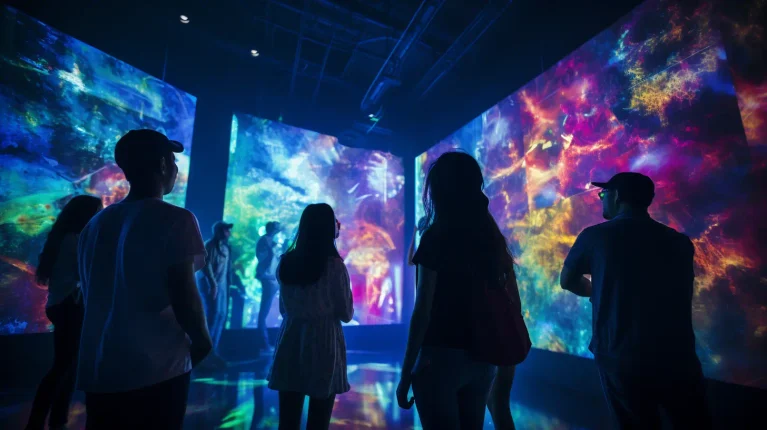
- Events: AR suits quick experiences; VR creates an immersive setting; MR places digital products in real space.
- Training: VR simulates procedures; AR displays instructions; MR combines digital models with real equipment.
- Sales and design: AR lets customers try products; VR presents spaces; MR supports collaboration on 3D models.
- Operations: AR or MR displays instructions, warnings, and data at the work location.
Operational applications need careful evaluation for accuracy and safety.
Checklist for Choosing VR, AR, MR, or XR
1. Define the experience goal
Choose VR to simulate something separate from the real environment; AR to overlay information; MR when digital objects must understand and respond to the space.
2. Define scale and duration
AR on phones scales easily. VR or MR headsets require queuing, cleaning, and support. Calculate the throughput per hour.
3. Check the environment
Lighting, floor area, network, surfaces, and movement zones all affect tracking. Testing at the deployment site is essential.
4. Estimate the entire system cost
Beyond devices, account for 3D production, programming, licenses, computers, operations, cleaning, and backups.
5. Design alternatives
Not everyone can wear a headset. Prepare a spectator screen, video, touch interaction, or a phone version.
Common Mistakes
- Using XR as the name of a specific type of headset.
- Calling every image overlay MR without checking spatial mapping.
- Choosing VR for an activity that must serve a large number of visitors in a short time.
- Producing content before finalizing devices and movement areas.
- Counting only the price of headsets and ignoring software and operating costs.
- Not checking for motion sickness, safety, and alternative access options.
Conclusion
When comparing VR, AR, MR, and XR, look at the level of immersion, spatial understanding, devices, and behavior. VR creates a digital environment; AR adds content; MR deeply connects the two environments; XR covers the whole group of solutions.
ADT Global can support you from consulting through content production and integration. Contact ADT Global to choose a solution that fits your project goals.
Frequently Asked Questions
Is XR a type of headset?
No. XR is an umbrella term for many technologies and experiences, not a single device.
Does AR require wearing glasses?
Not necessarily. AR can run on phones, tablets, or specialized glasses.
Is MR the same as AR?
The two concepts overlap. MR usually emphasizes digital content that understands, anchors to, and interacts with the physical space.
Which technology is best for an exhibition?
It depends on the goals, session length, visitor volume, and budget. AR scales easily; VR is more immersive; MR suits complex spatial interaction.
Can VR, AR, and MR be combined in one project?
Yes. An XR journey can use several technologies at different touchpoints, as long as the experience is clearly connected.