
R&D capability of Vietnamese tech companies
Technology companies cannot sustain an advantage if they only buy off-the-shelf solutions. When markets change quickly, in-house research and development capability becomes the foundation for creating differentiated products.

Technology companies cannot sustain an advantage if they only buy off-the-shelf solutions. When markets change quickly, in-house research and development capability becomes the foundation for creating differentiated products. Technology R&D in Vietnam is therefore no longer a matter for research institutes or large corporations alone. It is a capability that every business needs if it wants to own its products, data, and market.
The R&D capability of Vietnamese businesses shows in their ability to choose the right problems, develop prototypes, test, protect intellectual property, and commercialize. Vietnam has advantages in technical talent and an application market. However, businesses need to invest for the long term, connect with institutes and universities, and measure R&D by business value rather than merely counting ideas.
1. What is technology R&D in Vietnam?
R&D stands for Research and Development. Under the common classification, R&D includes basic research, applied research, and experimental development. World Bank data also uses this scope when reporting national R&D expenditure. [Source: World Bank]
Within a business, R&D does not necessarily begin with a large laboratory. It can start from a customer’s problem. The team then researches solutions, builds prototypes, tests, and improves before bringing the product to market.
Therefore, technology R&D in Vietnam should be understood as the capability to create new knowledge, products, or processes in the Vietnamese context. The results can be software, devices, algorithms, materials, manufacturing processes, or service models.
2. Why has R&D become a strategic capability?
Businesses that depend entirely on external technology often struggle to differentiate themselves. They also face risk when license prices, supplier policies, or supply chains change.
In contrast, investing in R&D makes a business more proactive in four areas:
Speed: respond faster when customer behavior changes.tế.
Product: create features suited to the market’s specific needs.
Technology: master core components instead of merely assembling.
Cost: optimize processes and reduce long-term dependence.
R&D also helps businesses move up the value chain. Instead of only doing contract manufacturing, a company can own designs, data, software, or intellectual property.
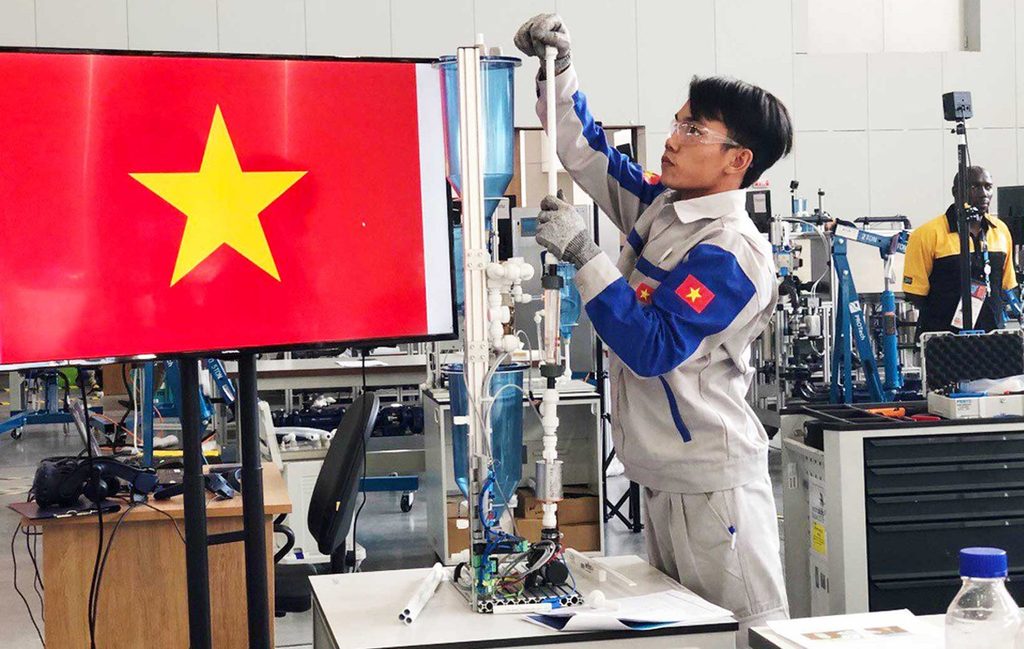
3. Five layers that make up a business’s R&D capability
- Strategy: define which problems are worth investing in, who the customers are, and what advantage to create.
- People: combine engineers, domain experts, product designers, and people who understand customers. Knowledge must be captured in documents and processes.
- Data and infrastructure: prepare computing capacity, measuring equipment, and simulation or validation environments suited to each stage.
- Experimentation: every prototype needs a hypothesis, evaluation criteria, and a next decision. Ineffective directions must be dropped early.
- Commercialization: standardize the product, calculate costs, protect intellectual property, and build sales channels.
4. What advantages do Vietnamese technology companies have?
Vietnamese companies have a young engineering workforce, a dynamic tech community, and the ability to pick up new trends quickly. The domestic market also offers many settings for experimentation, from smart manufacturing to finance, healthcare, and energy.
Localization is a notable advantage. A solution that understands the Vietnamese language, domestic processes, and local behavior can create value that differs from a generic product built for many markets.
According to WIPO’s Global Innovation Index 2025, Vietnam ranks 44th out of 139 economies. The result shows that a foundation for innovation has formed. However, a national ranking is no substitute for building capability inside each company. [Source: WIPO – Global Innovation Index 2025]
5. Bottlenecks in technology R&D in Vietnam
- Short-term investment: demanding revenue too early leads teams to choose only small improvements.
- Research far from the market: engineering and business do not define the problem together from the start.
- Fragmented infrastructure: a lack of standardized data, testing environments, or validation equipment.
- Difficulty retaining talent: experts need a career path, the freedom to experiment, and a learning environment.
- Weak intellectual property management: source code, trade secrets, and ownership rights are not protected from the outset.
6. Building an R&D model suited to Vietnamese businesses
Businesses do not need to copy the model of an international corporation. A lean structure can have three tiers:
- Discovery team: gathers problems, trends, and technologies.
- Development team: builds prototypes and tests them with users.
- Product team: standardizes, integrates, and brings the solution to market.
The teams share one project portfolio and one set of stage-gate criteria. An idea moves forward only when there is evidence. A project can also be stopped if costs rise while the value remains unclear.
Businesses should connect with universities, research institutes, startups, and technology partners. Vietnam Innovation Challenge 2025 is one example. Under the ViGen project, the parties jointly develop open-source Vietnamese data, toolkits, and an evaluation framework for AI models. [Source: NIC – Vietnam Innovation Challenge]
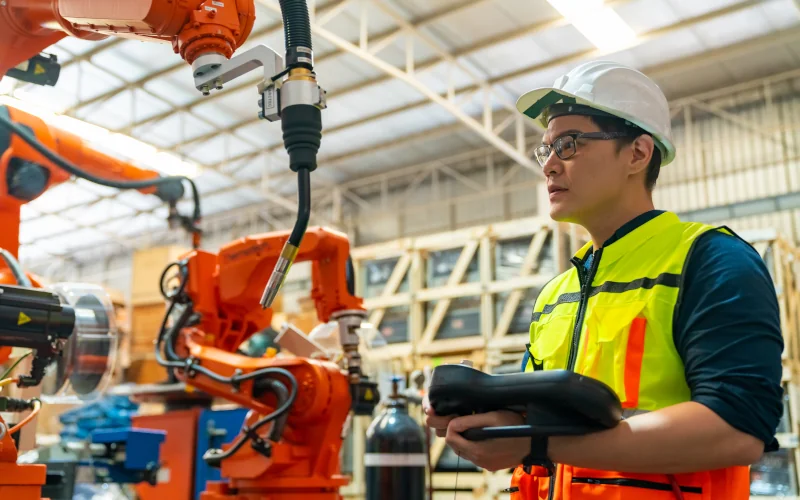
7. Which indicators measure R&D capability?
The number of ideas or the size of the budget does not fully reflect effectiveness. Businesses should track indicators in three groups.
| Group | Suggested indicators |
|---|---|
| Input | Budget, staff, research time, data, and equipment |
| Process | Time to prototype, percentage of experiments completed, number of improvement cycles |
| Output | New products, revenue, cost savings, patents, adoption rate |
It is also necessary to measure the time from idea to experiment and from experiment to market. Projects that create data or core technology must use different criteria from commercial projects.
8. R&D opportunities for Vietnamese technology companies
In AI, the opportunities lie in Vietnamese-language models, AI agents, industry-specific data, and secure deployment platforms. In manufacturing, businesses can research robotics, computer vision, Digital Twin, and predictive maintenance.
In energy, R&D focuses on asset monitoring, operational optimization, and emissions-reduction technology. In healthcare and education, the major needs are systems that support experts, personalized services, and data protection.
What they have in common is that a product must solve a specific problem. New technology creates an advantage only when it is integrated into processes and delivers measurable results.
Conclusion
Technology R&D capability in Vietnam is not determined by the size of the research lab. What matters more is the ability to turn problems into hypotheses, experiments into products, and knowledge into competitive advantage.
Businesses should start with a clear portfolio of problems. They then need to build a cross-disciplinary team, standardize processes, and measure effectiveness at each stage. When R&D is tied to the market, research investment can create long-term growth.
Contact ADT Global to discuss R&D, AI integration, Digital Twin, robotics, and technology solutions suited to your business’s problems.
Frequently Asked Questions
What activities does technology R&D in Vietnam include?
It includes research, prototyping, testing, improvement, and commercialization.
Do small businesses need a dedicated R&D department?
Not necessarily. A business can set up a small team and cooperate with institutes and universities.
How does R&D differ from innovation?
R&D creates knowledge and technology. Innovation also includes applying new processes or business models.
How long does it take for an R&D project to produce results?
It depends on complexity. Projects should be divided into verification milestones.
How can the risks of R&D investment be limited?
Choose a clear problem, experiment on a small scale, set stopping criteria, and check customer demand.